
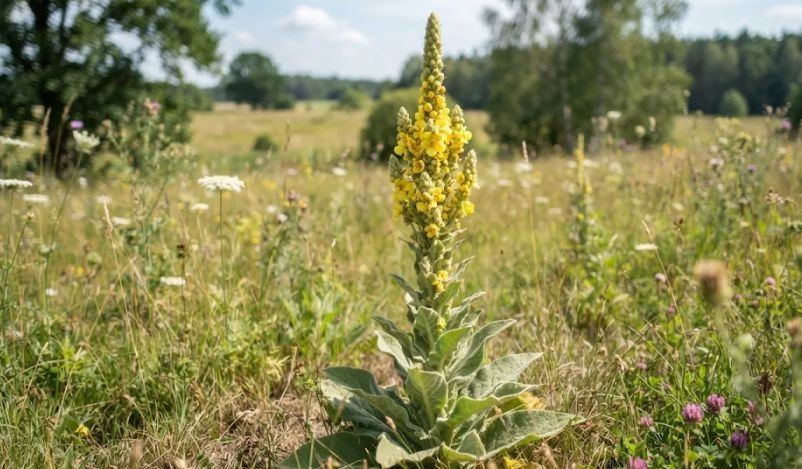
A single mullein plant can release 100,000 to 240,000 seeds, and some have sprouted after a century buried in Michigan soil. Such persistence is why this woolly weed now grows in every US state and much of Australia.
Few plants stand out like mullein, with its silver-green felt leaves and a yellow flower spike taller than most people.
It has been a torch, a lamp wick, a hair dye, a fish poison and, more recently, a social media tea.
Living in Eastern Nigeria, I know mullein only by reputation, yet stories about it reach me constantly and fuel my curiosity.
Details here draw on extension services, weed agencies, historical herbals and European regulators, each named in the text.
Sections on the mullein plant run from identification and growth to history, tea, research and safety, with deeper guides linked.
Safety note: mullein leaf hairs can irritate the throat and skin, and its safety in pregnancy, breastfeeding and young children has not been established.
Always consult your personal healthcare provider before adding new supplements to your routine, especially if you are pregnant, nursing, or taking prescription medications.
Table of Contents
What Is the Mullein Plant?
Common mullein, Verbascum thapsus, belongs to the figwort family, Scrophulariaceae, and is also called great mullein or woolly mullein.
UW-Madison Extension’s mullein profile lists its native range as Europe, northern Africa and Asia.
It is usually a biennial, forming a low rosette in year one and a single tall flowering stalk in year two.
The whole plant dies after flowering, and it spreads only by seed rather than by roots or runners.
Quick Facts
| Feature | Detail | Source |
|---|---|---|
| Botanical name | Verbascum thapsus | UW-Madison Extension |
| Family | Scrophulariaceae (figwort) | UW-Madison Extension |
| Life cycle | Biennial, sometimes annual or short-lived perennial | USDA Forest Service FEIS |
| Leaves | Between 4 and 12 inches long, densely hairy | UW-Madison Extension |
| Flower stalk | 5 feet or more, sometimes over 7 feet | UW-Madison, FEIS |
| Seeds per plant | 100,000 to 240,000 | UW-Madison Extension |
| Native range | Europe, northern Africa, Asia | UW-Madison Extension |
Names Gathered Over Centuries
The Herb Society of America traces the genus name to the Latin barbascum, meaning bearded, a nod to the furry leaves.
Maud Grieve’s 1931 herbal, A Modern Herbal, lists dozens of folk names, from Aaron’s Rod and Jacob’s Staff to Hag’s Taper.
Others include Velvet Plant, Our Lady’s Flannel, Candlewick Plant, Shepherd’s Clubs, Beggar’s Blanket and Feltwort.
Weeds Australia adds Shepherd’s Club and Velvet Weed among the names used there.
The stories behind these names are collected in mullein’s many folk names.
How to Recognize Mullein
Mullein leaves are bluish gray-green, oblong and so hairy that they feel like flannel, according to UW-Madison Extension.
The second-year stalk rises from the rosette’s center, crowded with small, five-petaled yellow flowers on a dense spike.
Step-by-step field marks for every season are set out in recognizing mullein in the field.
The First-Year Rosette
The first-year plant hugs the ground as a flat circle of velvety leaves, needing a winter’s cold before it can flower.
In one Michigan field, a US Forest Service review notes, rosettes under about 3.5 inches across failed to flower the next year.
How the two growth stages differ is compared in rosettes versus flowering stalks.
Lookalikes Worth Knowing
Lamb’s ear, a soft gray garden plant with similarly woolly leaves, can be mistaken for a mullein rosette.
Leaf size, stem form and flower color separate them, as telling lamb’s ear apart explains in detail.
Spotting Mullein in Winter
Dead second-year stalks stand brown and upright through winter, still packed with seed capsules along their upper length.
Winter clues, including dried stalks and surviving rosettes, are covered in mullein’s cold-season appearance.
Flowers and Bloom Season
Each flower opens before dawn and closes by mid-afternoon, with blooms climbing the spike from the bottom up, UW-Madison reports.
Bloom timing varies by region, from June to September across much of the eastern US to March through November along Gulf coasts.
South of the equator the calendar flips, and an Australian plant guide gives a November to March season for New South Wales.
Taller stalks bloom for longer, and unpollinated flowers can pollinate themselves at the end of the day.
Regional timing and flower structure are detailed in when mullein flowers open.
Bees and Other Visitors
Bees, flies and butterflies all visit the flowers, but short and long-tongued bees are the effective cross-pollinators.
Wildlife links, including the seed-eating weevil, are covered in insects that visit mullein.
Where Mullein Grows
The USDA Forest Service species review by Corey Gucker reports the mullein plant in every US state, including Alaska and Hawaii, and southern Canada.
Early settlers brought seed to the eastern US before the Revolutionary War, reportedly to stun fish for easy collection.
In Hawaii, first reported in 1932, mullein covered more than 770 square miles by 1990, according to the same review.
Weeds Australia’s great mullein profile records it in every state and territory except the Northern Territory.
It arrived there as a garden plant, appearing in nursery catalogues from 1845 and becoming naturalized in Victoria by 1887.
Grieve describes it growing throughout Britain except the far north of Scotland, on hedge banks, roadsides and waste ground.
Preferred Conditions
- Full sun, since the plant is shade intolerant and easily outcompeted by taller vegetation.
- Disturbed sites like roadsides, fence rows, vacant lots, burned areas and neglected pastures.
- Dry, sandy or gravelly soils, though it tolerates many soil types where light is plentiful.
Range maps and soil preferences are expanded in mullein’s range and soils.
Seeds That Last for Generations
UW-Madison Extension counts 200 to 300 capsules per plant, each holding 500 to 800 tiny, pitted brown seeds.
The Forest Service review notes the seeds measure only 0.4 to 0.8 millimeters long and mostly fall within about 3 feet.
Seeds germinated after 100 years in Michigan State University’s Beal seed experiment, UW-Madison reports.
Because light triggers germination, disturbing soil can bring buried seed to the surface and restart a population.
Gathering ripe seed for planting next year is covered in saving seed from stalks.
Growing Mullein at Home
UW-Madison notes the mullein plant is sometimes grown as an ornamental, with seed sown on the soil surface in late spring.
A sunny, well-drained spot suits it best, and cutting stalks before seed ripens keeps it from spreading.
Sowing depth, spacing and care are covered in starting mullein from seed.
Garden Mulleins and Related Species
Verbascum is a large genus, and moth mullein, Verbascum blattaria, is another common roadside species in North America.
The Herb Society notes that garden cultivars ‘Gainsborough’, ‘Letitia’ and ‘Pink Domino’ hold the Royal Horticultural Society’s Award of Garden Merit.
European regulators also recognize Verbascum densiflorum and Verbascum phlomoides flowers alongside common mullein in herbal products.
Wild species and named garden cultivars are compared side by side in mullein species and cultivars.
Weed Status and Control
Colorado places common mullein on its List C of noxious weeds, meaning it is too widespread for statewide eradication.
Victoria is the only Australian state that declares great mullein a weed, according to Weeds Australia.
UW-Madison, by contrast, says it is generally not aggressive in Wisconsin and rarely troubles gardens or tidy yards.
In Britain and Ireland it is no invader at all, since the Royal Horticultural Society counts it among native wildflowers.
Ecology and weed laws by region are weighed in how invasive mullein is.
Control Methods
- Hand-pull, hoe or dig plants before they set seed, ideally when soil is moist.
- Avoid mowing alone, because UW-Madison says rosettes grow larger and bolt once mowing stops.
- Keep dense ground cover in place, since bare, disturbed soil invites new seedlings.
- Add a surfactant if using herbicide, since dense leaf hairs block uptake, and follow every label exactly.
Removal steps for lawns, pastures and gardens appear in clearing unwanted mullein.
Weed rules vary for other wild herbs too, as growing dock on purpose shows for yellow dock.
Harvesting, Drying and Storing
Leaves and flowers are the parts most people gather, and timing matters for both quality and the plant’s life cycle.
Picking from clean sites away from sprayed roadsides is wise for any wild herb, mullein included.
Timing by plant stage is covered in picking mullein leaves, while drying mullein at home walks through preservation.
Store dried leaves in sealed jars somewhere dark and cool, following keeping dried leaves potent.
Mullein Tea
Mullein tea is usually brewed from dried leaves or flowers, steeped in hot water and then strained carefully.
The European Medicines Agency’s herbal monograph on mullein flower lists 1.5 to 2 grams of flower in 150 milliliters of boiling water.
That monograph, adopted in March 2018, sets this infusion for adults and adolescents three to four times daily.
Step-by-step brewing lives in brewing mullein leaf tea, and its flavor is described in how mullein tea tastes.
Why Straining Matters
Banner Health warns that poorly strained mullein tea can leave leaf hairs that irritate the throat.
Filter choices, from paper to fine cloth, are compared in filtering out leaf hairs.
Brewing other herbal teas follows similar habits, as steeping elderberry tea shows for a very different plant.
Historical and Traditional Uses
Grieve quotes the herbalist Parkinson describing stalks dipped in suet and burned as torches, the origin of the name Torches.
The dry leaf down made excellent tinder and served as lamp wicks before cotton was available, according to the same herbal.
Grieve also records Roman women using a flower infusion to dye their hair golden, a claim she reports rather than tests.
UW-Madison notes the flowers produced yellow, green or brown dyes, depending on how they were processed.
Seeds were used to stupefy fish, and UW-Madison records this use in Virginia in the mid-1700s.
Grieve links that effect to saponins, citing a 1902 report of 6 to 13 percent saponin in a related Greek species.
Herbal tradition used mullein for coughs and diarrhea and applied it externally to skin complaints, UW-Madison adds.
These are historical uses, not proven treatments, and the fish-poison history is a reason to leave the seeds alone.
Torches and Toilet Paper
The torch tradition, including the Hag’s Taper name, is traced in mullein stalk torches.
Soft, broad leaves earned mullein the nickname cowboy toilet paper, a use described in mullein on the trail.
What Research Says
Research on mullein is limited, and most studies were done in laboratories rather than in people.
In a September 2025 Banner Health lung health article, pulmonologist Madhav Chopra describes the early studies as small and limited.
The EMA accepts mullein flower only as a traditional remedy for sore throat linked to dry cough and colds.
That status reflects generations of use rather than clinical trials proving the flowers work.
One 2001 trial in children with ear pain tested drops combining mullein, garlic, calendula and St John’s wort in olive oil.
The American Family Physician summary reports those drops relieved pain as well as anesthetic drops, though mullein was not tested alone.
Safety Notes
The EMA does not recommend mullein flower tea for children under 12 or while pregnant or breastfeeding, citing insufficient data.
Banner Health lists possible allergy in people sensitive to figwort-family plants, mild stomach upset and skin irritation.
The same article notes possible interactions with diuretics and anti-inflammatory medicines, so check with a pharmacist first.
If symptoms persist beyond one week of use, the EMA says to consult a doctor or qualified practitioner.
Always consult your personal healthcare provider before adding new supplements to your routine, especially if you are pregnant, nursing, or taking prescription medications.
Buying Mullein Products
Chopra notes that US mullein products are not standardized the way European products are.
Look for Verbascum thapsus on the label and third-party testing from groups such as NSF or USP.
Broader label checks before any herbal purchase are listed in label checks for herbs.
Related Herbs on Six Herbs
Yellow dock is another Eurasian roadside plant now common across North America, profiled in the yellow dock plant page.
American elder is a native North American shrub with edible cooked berries, covered in elder from flower to berry.
Every herb covered on the site is listed in the Six Herbs index.
Conclusion
The mullein plant is a woolly Eurasian biennial that now grows in every US state and much of Australia.
One plant can shed up to 240,000 seeds, some still viable after a century in soil.
Torches, lamp wicks, dyes and fish poison mark its long history, while modern interest centers mostly on tea.
The EMA recognizes mullein flower only as a traditional remedy, and human research remains very thin.
Strain every cup carefully, get medical advice for any remedy use, then keep Six Herbs open for further mullein questions.
Frequently Asked Questions
Is the mullein plant native to North America?
No, UW-Madison Extension lists Europe, northern Africa and Asia as its native range. Settlers brought it to the eastern US, and today it grows in every US state.
How tall does mullein grow?
The second-year flowering stalk usually reaches 5 feet or more, UW-Madison Extension reports. The US Forest Service review notes some flowering plants exceed 7 feet in total height.
Why is mullein called Hag’s Taper?
Grieve’s herbal links the name to suet-dipped stalks burned as torches and to leaf-down wicks. An old superstition, Grieve adds, held that witches burned lamps with such wicks.
Can you eat mullein?
No herbal or botanical source consulted here treats mullein as an edible food plant. Its seeds were historically used to stun fish, so never eat them at all.
Disclaimer: Six Herbs is an educational resource, not a medical service. Nothing in this article constitutes medical advice, diagnosis, or treatment. Always consult a qualified healthcare provider before using any herb medicinally, particularly if you are pregnant, breastfeeding, taking medication, or managing a health condition.