
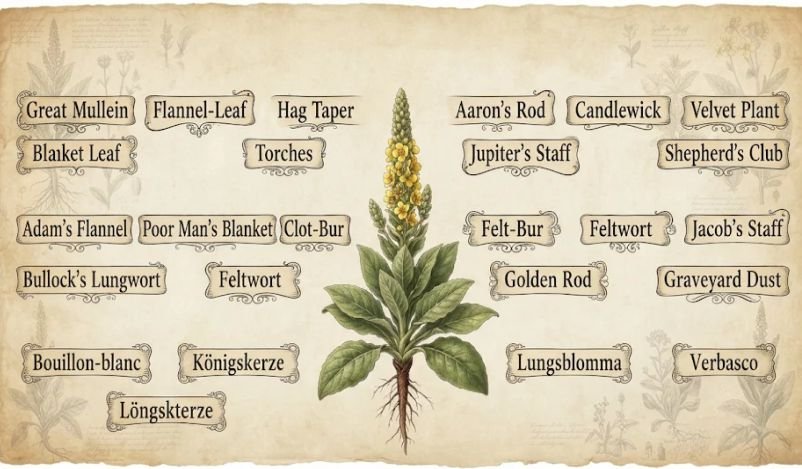
Maud Grieve’s 1931 A Modern Herbal lists more than thirty synonyms for great mullein, from Aaron’s Rod to Hag’s Taper. Each of those other names for mullein preserves a small piece of history about how people once used the plant.
Mullein has collected a remarkable pile of nicknames, and most of them describe something you can see, touch or use.
In Igbo, the herbs of my childhood carried everyday names like uziza and utazi, so a plant with thirty English names makes me smile.
None of these mullein names come from my own region, so every one here is traced to herbals, botanists and naturalists.
Learning the other names for mullein also helps when reading old herbals, seed catalogs or regional field guides from other countries.
Botany, growing notes and tea are all covered in the whole-plant mullein article instead.
Safety note: several folk names recall old remedies, which are history rather than advice, so ask a doctor before any medicinal use.
Always consult your personal healthcare provider before adding new supplements to your routine, especially if you are pregnant, nursing, or taking prescription medications.
Table of Contents
Mullein Names by Theme
This table groups mullein’s many nicknames by the feature or use that lies behind them.
| Theme | Example names | Source |
|---|---|---|
| Soft, woolly leaves | Velvet Dock, Our Lady’s Flannel, Velvet Plant, Adam’s Flannel, Blanket Herb, Beggar’s Blanket, Feltwort, Flannel Leaf | Grieve, Star Tribune |
| Torches and wicks | Hag’s Taper, Torches, Candlewick Plant, Our Lady’s Candle, Hedge Taper | Grieve |
| Tall, rigid stalk | Aaron’s Rod, Jupiter’s Staff, Jacob’s Staff, Peter’s Staff, Shepherd’s Clubs, Beggar’s Stalk | Grieve |
| Old livestock remedies | Bullock’s Lungwort, Clown’s Lungwort, Cuddy’s Lungs | Grieve, Eloise Butler garden |
| Outdoor use | Cowboy’s Toilet Paper | Herb Society of America |
| Australian weed names | Shepherd’s club, velvet weed | Weeds of Melbourne |
Where the Word Mullein Comes From
Two different explanations for the word mullein appear in the sources reviewed here.
The Eloise Butler garden’s mullein notes trace it to the Latin mollis, meaning soft, which suits the velvety leaves.
Grieve’s A Modern Herbal entry offers a different route, citing the writer Prior on Anglo-Saxon moleyn and Old French malen.
Prior linked those words to the Latin malandrium, meaning malanders, an old disease term that Grieve also connects with cattle.
Neither origin can be settled here, so both are presented as their sources give them.
Verbascum and Thapsus
The genus name Verbascum is a corruption of barbascum, from the Latin barba, meaning beard, according to Grieve.
The beard refers to the plant’s shaggy foliage, and Grieve credits Linnaeus with applying the name.
The species name thapsus probably honors Thapsus, an ancient settlement in Africa, the Eloise Butler notes suggest.
Related species and garden types share the Verbascum name, as mullein’s garden cousins shows.
Names From Soft, Woolly Leaves
The largest group of names celebrates the thick felt on mullein’s leaves.
Grieve lists Velvet Dock, Velvet Plant, Blanket Herb, Beggar’s Blanket, Feltwort, Fluffweed and Woollen among them.
Flannel names form their own cluster, with Our Lady’s Flannel, Adam’s Flannel and Old Man’s Flannel all recorded by Grieve.
A 2026 Minnesota Star Tribune feature adds flannel leaf, calf’s tongue and velvet plant, linking them to hairs thickest on leaf undersides.
The Herb Society’s mullein post ties velvet plant to the soft, furry rosette of a plant’s first year.
Grieve also lists Wild Ice Leaf, which she suggests may refer to the leaves’ whitish look.
Leaf texture as a field mark is covered in how mullein leaves feel.
Names From Torches and Wicks
Another cluster recalls mullein’s role as a source of light before cheap candles and cotton wicks.
Grieve explains that the down on dried leaves and stems made good tinder and stood in for lamp wicks until cotton arrived.
That use gave rise to names such as Candlewick Plant and Torches, she writes.
Hag’s Taper links to an old superstition that witches used such wicks, though Grieve notes that hag may come from the Anglo-Saxon word for hedge.
Our Lady’s Candle and Hedge Taper fit that reading, describing a tall yellow spike glowing like a candle in the hedge.
The Herb Society adds Hag’s Candle, tied to dried stalks dipped in tallow or wax, then lit as torches.
The full torch story, including how stalks were prepared, lives in mullein stalks as candles.
Names From the Tall Stalk
The stem’s rigid uprightness accounts for several local names, according to Grieve’s herbal.
Aaron’s Rod, Jupiter’s Staff, Jacob’s Staff, Peter’s Staff and Shepherd’s Staff all belong to this group.
Shepherd’s Clubs and Beggar’s Stalk follow the same idea of a straight, sturdy stick.
Aaron’s Rod is also used for other plants, the Eloise Butler notes warn, so context matters when reading old records.
In Australia, Weeds of Melbourne’s mullein page names great mullein as velvet weed and shepherd’s club.
The tall second-year stalk behind these names is described in the year mullein bolts.
Names From Old Remedies
A few names recall historical uses on farms, which are recorded here as history rather than advice.
Bullock’s Lungwort comes from stockmen using the plant for respiratory illness in cattle, according to the Eloise Butler notes.
Grieve cites Coles in 1657, who wrote that Kent farmers gave it to cattle with a lung cough.
Clown’s Lungwort reflects an old English view that home remedies were somewhat clownish, the Eloise Butler notes explain.
Grieve also lists Cuddy’s Lungs, a further lung-themed name that her herbal leaves unexplained.
These lung-themed farm names show how closely the plant was once tied to rural life in Britain.
Always consult your personal healthcare provider before adding new supplements to your routine, especially if you are pregnant, nursing, or taking prescription medications.
Modern and Outdoor Names
Cowboy’s toilet paper is a playful nickname, and the Herb Society notes the leaves were occasionally used that way.
Grieve’s list even includes Rag Paper, which hints at the soft, absorbent feel of the leaves.
Practical tips and cautions for trail use sit in mullein leaves on camping trips.
Golden Rod also appears in Grieve’s list, though today that name belongs firmly to Solidago, a different plant entirely.
Why the Names Matter
Knowing these many nicknames helps whenever old recipes, seed lists or regional guides use an unfamiliar or local label.
Shared names can mislead, as Aaron’s Rod and Golden Rod show, so the botanical name Verbascum thapsus remains the safest check.
Fuzzy lookalikes with their own names, such as lamb’s ear, are compared in lamb’s ear or mullein.
Names of Other Six Herbs Plants
Yellow dock is also widely called curly dock, as the yellow dock home page notes.
Moringa has its own string of names, drumstick tree among them, and the moringa overview introduces the plant.
Conclusion
Mullein has gathered more than thirty folk names, many recorded by Maud Grieve in her famous 1931 herbal.
Most describe its woolly leaves, its tall stalk or its old role as a torch, candle and wick.
Others recall farm remedies for cattle, which belong to history rather than to modern health advice.
Keeping these colorful nicknames in mind makes old herbals, seed catalogs and regional guides far easier to read.
Check the botanical name before picking, raise any medicinal plans with your doctor, and return for the next mullein post.
Frequently Asked Questions
What are other names for mullein?
Common ones include velvet dock, flannel leaf, Aaron’s rod, hag’s taper and candlewick plant. Maud Grieve’s 1931 herbal lists more than thirty such names in its mullein entry.
Where does the name hag’s taper come from?
Grieve links the name to an old superstition that witches burned mullein wicks for light. She also notes hag may come from the Anglo-Saxon word for hedge instead.
Where does the word mullein come from?
Sources disagree, with one tracing it to the Latin mollis, meaning soft. Grieve instead cites the Anglo-Saxon moleyn and Old French malen, linked to the Latin word malandrium.
What does Verbascum mean?
Grieve explains that Verbascum is a corruption of barbascum, from the Latin barba, meaning beard. The name points to the plant’s shaggy foliage, especially its thick leaf hairs.
Disclaimer: Six Herbs is an educational resource, not a medical service. Nothing in this article constitutes medical advice, diagnosis, or treatment. Always consult a qualified healthcare provider before using any herb medicinally, particularly if you are pregnant, breastfeeding, taking medication, or managing a health condition.

Chims Clements writes about herbs from personal experience and careful research. Growing up in Aba, Nigeria, moringa and tamarind were everyday household plants long before they became globally recognised superfoods. He uses both regularly in his home today. At Six Herbs he goes deep on moringa, tamarind, fenugreek, and sea moss — building honest, experience-backed content that separates what tradition knows from what science confirms. The content on this site is for informational purposes only and is not medical advice. Always consult a healthcare provider before using herbs medicinally.