
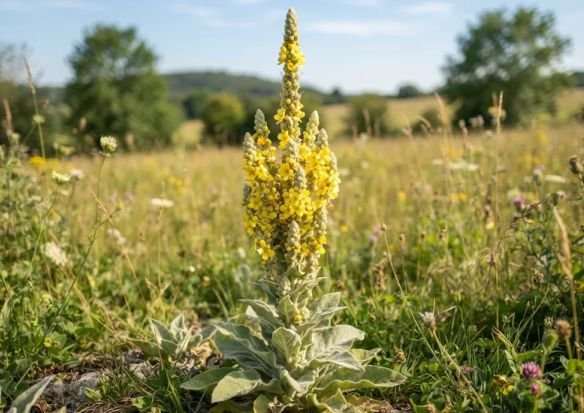
John Parkinson wrote that earlier generations dipped mullein stalks in suet before burning them, at funerals or otherwise, and the Latins called it Candela regia. That royal candle, Grieve’s herbal records, is the plant behind every mullein torch tale told.
Long before electric light, people turned to tall, dry mullein stalks and their fluffy down for fire and illumination.
That history still survives in old names such as Torches, Candlewick Plant and Hag’s Taper.
Mullein torches belong to a past I know only through old herbals and modern naturalists, not through any stalk I have lit.
Grieve, Gerard, America’s Herb Society and a handful of other writers supply the details here.
Tracing the mullein torch from Roman times to modern folk craft also means covering fire safety.
Plant basics, tea and growing all live together in the mullein topic hub.
Safety note: burning dried plant stalks is a fire risk, so follow local fire rules, and ask a doctor before any medicinal use of mullein.
Always consult your personal healthcare provider before adding new supplements to your routine, especially if you are pregnant, nursing, or taking prescription medications.
Table of Contents
Roman and Classical Torches
Country Life’s mullein history traces mullein torches back to Roman times, when dried stalks formed their base.
A 2022 folklore column in Kentucky says Roman soldiers dipped the tall flower stalks in tallow to light their quarters.
Interlochen Public Radio’s 2024 segment describes the same tallow-dipped torches, used from the Roman Empire well into the Middle Ages.
Parkinson’s Latin names for the plant, Candela regia and Candelaria, point to the same candle-like use.
These accounts come from folklore writers and old herbals rather than archaeology, so treat the Roman details as tradition.
Funeral Lights and Hedge Tapers
Maud Grieve’s mullein entry quotes Parkinson on suet-dipped stalks burned at funerals and on other occasions.
Gerard described it as a plant from which a kind of link, or torch, could be made once tallowed.
Writing in 1578, Henry Lyte compared the flowering top to a wax candle or taper cunningly wrought.
Grieve adds that the yellow spike suggested a tall candle growing in the hedge, hence Hedge Taper.
Hag’s Taper and the Witch Legend
Grieve connects the name Hag’s Taper with an old belief that witches lit their spells with mullein-wicked lamps.
She also floats a plainer origin, with hag possibly coming from haege, an old English word for hedge.
The Herb Society’s candle history adds Hag’s Candle to the list and repeats the tallow-dipping story.
Kentucky’s folklore column says witches burned the plant as a torch too, which it gives as the source of the Hag’s Taper name.
Gerard’s base mullein chapter uses Hag-Taper as an everyday name for common mullein.
Every other folk name of this kind is collected in mullein’s light-related nicknames.
Wicks and Tinder
Mullein’s down was as useful as its stalks, since Grieve says it made excellent tinder when dry, igniting from the slightest spark.
Before cotton, that down also served for lamp wicks, which gave rise to the name Candlewick Plant.
Country Life describes dried stalks acting as the central core of tallow candles in that pre-cotton era.
After colonists brought mullein to America, its fibers were used as candlewicking, according to Interlochen Public Radio.
Kentucky’s folklore column says the thick down is still used for candle wicks in parts of Europe.
How a Mullein Torch Was Made
Historical accounts agree on a simple method: a dry flower stalk dipped in fat, then lit.
Parkinson named suet, while later writers mention tallow or wax, both fuels that soak into the dry spike.
The dense seed head and woolly coating probably held the fat well, an untested guess rather than a recorded fact.
Stalks for this purpose come from second-year plants that have finished flowering, as stalks left after seeding explains.
Dry winter stalks are easy to spot, a stage described in mullein’s brown winter spires.
That simplicity explains why the mullein torch survives today as a seasonal folk craft.
Fire Safety for Modern Torch Makers
Anyone tempted to recreate a mullein torch should treat it as an open flame with serious fire risks.
Grieve’s note that the down ignites from the slightest spark is a warning as much as a selling point.
NFPA data cited by the Illinois State Fire Marshal shows candles caused 2 percent of reported US home fires from 2015 to 2019.
In 60 percent of those candle fires, something flammable sat too close to the flame.
- Burn torches only outdoors, on bare ground or stone, away from dry grass and buildings.
- Check local fire restrictions and burn bans before lighting anything in dry weather.
- Keep water or a fire extinguisher within reach, and never leave a lit torch unattended.
- Give a torch far more clearance than the 1 foot the fire marshal recommends around candles.
- Keep children and pets well back, since dripping fat and falling embers can burn.
Weed laws matter too, since moving seed-laden stalks can spread mullein, as mullein’s spread and weed status explains.
Gathering stalks without scattering seed is covered in bagging stalks before cutting.
Always consult your personal healthcare provider before adding new supplements to your routine, especially if you are pregnant, nursing, or taking prescription medications.
More Plant Folklore
Elder has a long folklore of its own, introduced in elder through the ages.
Conclusion
Mullein lit homes, camps and funerals for centuries, through suet-dipped stalks, downy tinder and simple lamp wicks.
Parkinson, Gerard, Lyte and Grieve all recorded the candle likeness that gave rise to Torches, Candlewick Plant and Hag’s Taper.
The witch legend may be folklore layered over a simpler hedge name, as Grieve suggests.
Today the mullein torch survives mostly as a seasonal craft, and it deserves the same care as any open flame.
Check fire rules first, bring medicinal questions to a doctor, and revisit the Six Herbs mullein collection anytime.
Frequently Asked Questions
What is a hag’s taper?
Hag’s Taper is an old name for great mullein, recorded by Gerard and Grieve. Grieve links it to witches’ lamps, though it may simply mean a hedge taper.
How were mullein torches made?
Historical accounts describe dry flower stalks dipped in suet, tallow or wax and set alight. Parkinson linked the practice to funerals and other occasions long ago, per Grieve.
Did Romans use mullein as torches?
Folklore writers say Roman soldiers dipped mullein stalks in tallow to light their quarters. Country Life traces mullein torches to Roman times, though archaeological evidence is not cited.
Is it safe to make a mullein torch?
It is an open flame, so burn it only outdoors, well away from dry grass. Check local fire restrictions first, keep water nearby and never leave it unattended.
Disclaimer: Six Herbs is an educational resource, not a medical service. Nothing in this article constitutes medical advice, diagnosis, or treatment. Always consult a qualified healthcare provider before using any herb medicinally, particularly if you are pregnant, breastfeeding, taking medication, or managing a health condition.

Chims Clements writes about herbs from personal experience and careful research. Growing up in Aba, Nigeria, moringa and tamarind were everyday household plants long before they became globally recognised superfoods. He uses both regularly in his home today. At Six Herbs he goes deep on moringa, tamarind, fenugreek, and sea moss — building honest, experience-backed content that separates what tradition knows from what science confirms. The content on this site is for informational purposes only and is not medical advice. Always consult a healthcare provider before using herbs medicinally.