
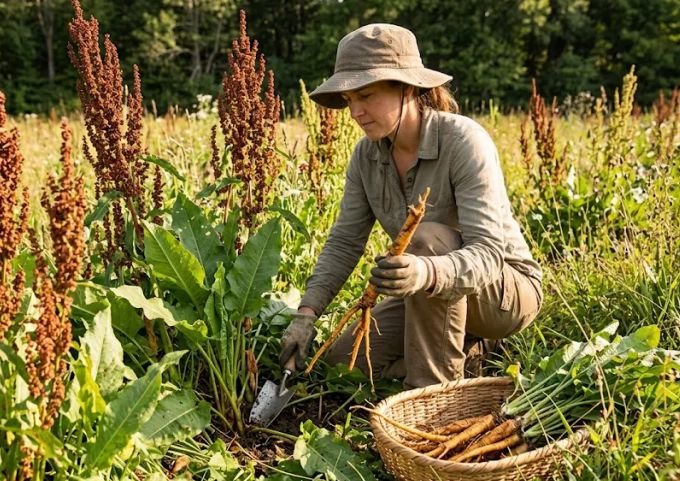
University of Maryland Extension notes that a curly dock taproot left partly in the ground can regrow into a new plant. Knowing how to harvest yellow dock root cleanly matters for that reason, and for the root you carry home.
Yellow dock grows in pastures, ditches and roadsides across much of the world, so finding a plant is rarely the hard part.
The hard parts are confirming its identity, choosing clean ground and lifting a deep, fleshy taproot without snapping it.
My plant work across Eastern Nigeria, which began in 2010, never involved yellow dock, so the method draws on extension services and herbal practice.
Here is how to harvest yellow dock root in a way that protects both you and the patch.
Readers who want the plant’s background can turn to the yellow dock root hub for an overview.
Safety note: dig only plants you can identify with certainty, avoid sprayed or roadside ground, and skip the root during pregnancy or kidney disease.
Always consult your personal healthcare provider before adding new supplements to your routine, especially if you are pregnant, nursing, or taking prescription medications.
Table of Contents
Confirm the Plant Before Anything Else
Curly dock forms a rosette of narrow leaves with wavy edges, and University of Maryland Extension measures those basal leaves at 6 to 12 inches long.
Its flowering stalks reach up to 3 feet and turn brown as the seeds ripen, a handy marker in late season.
A full field checklist lives in identifying curly dock correctly, and it is worth reading before any digging.
Some young rosettes can be confused with toxic plants, so check the dock lookalike list whenever the flower stalk is absent.
If any doubt remains after checking, leave that plant in the ground and look elsewhere.
Choose Clean Ground
Washington State University Extension lists roadsides, ditches and waste areas among curly dock’s usual habitats, and those are exactly the places to be careful.
A 2022 highway study in Sustainability found that lead and cadmium in crops fell as distance from the road increased.
Urban soil can carry metals as well, as a 2019 PLoS ONE wild greens study in Oakland, California showed.
One site held 700.9 mg/kg of soil lead, well above the EPA limit of 400 mg/kg the authors cited.
The same study detected no pesticides in rinsed dock leaves, yet it did not test dock roots, which sit in the soil itself.
Lawns and field edges are also common spray targets, since UMD lists several broadleaf herbicides for curly dock control.
Ask permission on private land, check local rules for public land, and choose sites well away from traffic and spraying.
When to Dig
Herbalist root-digging guidance, such as Urban Moonshine’s root digging notes, favors fall, when the plant has drawn its energy back into the root.
The same source suggests digging before the ground freezes, and it prefers younger roots of about one to two years.
Georgetown’s curled dock profile reports that how strongly the root acts as a laxative shifts with harvest season, so timing affects the result.
Moist soil makes the job easier, as UMD notes that pulling dock goes better when the ground is damp.
Spring digging is possible, but spring is also leaf season, and cooking young dock greens covers that harvest instead.
Tools for a Deep Taproot
WSU describes the taproot as deep and fleshy, and Urban Moonshine puts typical yellow dock roots at about a foot long.
- A garden fork loosens a wide circle of soil without slicing through the root the way a spade can.
- A hori hori or narrow dandelion digger helps work down beside the taproot in tight or rocky spots.
- A bucket of water and a stiff brush make the first cleaning easier before soil dries onto the root.
- Gloves protect your hands, and a cloth bag lets freshly dug roots breathe on the walk home.
How to Harvest Yellow Dock Root, Step by Step
The sequence below combines the extension advice above with common herbalist digging practice.
- Start digging about 8 inches out from the base of the plant, since some roots spread outward.
- Push the fork in deeply and lever gently, working around the plant in a full circle.
- Loosen the soil by hand near the crown instead of yanking the leaves, which can snap the taproot.
- Ease the whole root out once it moves freely, keeping as much length as possible.
- Shake off loose soil and cut the leaves away a short distance above the crown.
- Backfill the hole and firm the soil, leaving the site tidy for the next person.
Anyone learning how to harvest yellow dock root should expect a few broken roots at first, since dense clay grips a long taproot tightly.
Cleaning and First Processing
Wash the roots the same day, scrubbing the brown outer bark until the soil is gone but the skin stays on.
Cutting one open should reveal yellow flesh under that brown bark, an extra check though not proof on its own.
Urban Moonshine warns that undried roots can mold in storage, so chop them small and process them promptly.
Drying is the usual next step, and the root drying method covers temperatures and timing.
Fresh roots can also go straight into alcohol, an option set out in our dock tincture steps.
Dried pieces later feed a simmered root tea or home-ground dock powder.
Taking Only What You Need
UMD reports that a single plant can produce up to 60,000 seeds that stay viable in soil for as long as 80 years.
WSU adds that root fragments left behind can resprout, so a dug patch rarely disappears for good.
Even so, Urban Moonshine advises taking only about a year’s supply, which keeps any single site from being stripped.
If you would rather grow a clean, known source, planting dock on purpose covers containment.
Before You Use the Harvest
Knowing how to harvest yellow dock root safely is only half the job, since the root itself carries cautions.
Drugs.com’s dock root summary warns pregnant and breastfeeding women away from it and names bowel obstruction and kidney disease as further reasons to avoid it.
Reactions and interactions appear in side effects worth knowing, and expectant mothers should read dock safety in pregnancy first.
Always consult your personal healthcare provider before adding new supplements to your routine, especially if you are pregnant, nursing, or taking prescription medications.
Conclusion
Digging dock well starts with certain identification and clean ground, away from traffic, spraying and contaminated urban soil.
Fall is the favored season, moist soil helps, and a fork set about 8 inches out protects the taproot.
That is how to harvest yellow dock root without waste, followed by same-day washing and prompt drying.
Take about a year’s supply, expect the patch to regrow, and keep pregnancy and kidney cautions in mind.
Get a doctor’s advice before using what you dig, and let Six Herbs guide each careful next step.
Frequently Asked Questions
Which season suits digging yellow dock root?
Herbal digging guides favor fall, before the ground freezes and after energy returns to the root. Moist soil also makes lifting the root easier, according to UMD Extension.
How deep does a yellow dock root grow?
WSU Extension calls it deep and fleshy, and herbal sources describe typical roots of about a foot. Start digging about 8 inches from the base to avoid snapping it.
Is it safe to dig dock by the roadside?
Roadside soil can hold lead and cadmium, which a 2022 study found dropping with distance from traffic. Choose unsprayed sites well away from roads, railways and busy paths instead.
Will digging the roots wipe out a dock patch?
Rarely, since WSU notes root fragments resprout and UMD reports seeds lasting decades. Still, anyone learning how to harvest yellow dock root should take only a year’s supply.
Disclaimer: Six Herbs is an educational resource, not a medical service. Nothing in this article constitutes medical advice, diagnosis, or treatment. Always consult a qualified healthcare provider before using any herb medicinally, particularly if you are pregnant, breastfeeding, taking medication, or managing a health condition.

Chims Clements writes about herbs from personal experience and careful research. Growing up in Aba, Nigeria, moringa and tamarind were everyday household plants long before they became globally recognised superfoods. He uses both regularly in his home today. At Six Herbs he goes deep on moringa, tamarind, fenugreek, and sea moss — building honest, experience-backed content that separates what tradition knows from what science confirms. The content on this site is for informational purposes only and is not medical advice. Always consult a healthcare provider before using herbs medicinally.