
Most of the medicine cabinet traces back further than a lab. Aspirin came from willow bark, morphine from the opium poppy, and malaria’s first effective treatment from the bark of a South American tree. Herbs aren’t an alternative to modern medicine; in large part, they’re where it came from.
This guide covers what herbs actually are and the role they’ve played across human societies for thousands of years. I
t covers the specific, documented ways modern pharmaceuticals grew out of plant compounds rather than replacing them entirely.
It also covers why traditional herb use still matters today, alongside conventional medicine rather than in competition with it.
Finally, it points to the specific herb and topic guides on this site.
Disclaimer: Six Herbs is an educational resource, not a medical service. Nothing in this article constitutes medical advice, diagnosis, or treatment. Always consult a qualified healthcare provider before using any herb or supplement, particularly if you are pregnant, breastfeeding, taking medication, or managing a health condition.
Table of Contents
What Are Herbs?
Herbs are plants or plant parts used for flavor, nutrition, or wellness purposes, taken fresh, dried, powdered, or brewed into teas.
In the United States, herbal products sold as supplements are regulated differently from medications.
According to the National Center for Complementary and Integrative Health, herbal supplements are a type of dietary supplement.
The FDA does not review most of them for safety or effectiveness before they reach store shelves.
This is a meaningfully different standard than the one prescription drugs are held to.
Herbs in Human History and Society
Herbal use isn’t a fringe practice or a recent wellness trend; it’s closer to the historical default for how most of humanity has managed health.
The World Health Organization estimates that more than 80 percent of the population across most of its 194 member states currently uses some form of traditional medicine, herbal remedies included.
This is detailed in this WHO overview on integrating traditional medicine into health care.
For many people, particularly in regions where formal healthcare access is limited, traditional herbal knowledge isn’t a supplement to their healthcare; it’s the main system they actually have.
This shows up differently across cultures, but the underlying pattern repeats everywhere.
The Ebers Papyrus, an Egyptian medical text roughly 3,500 years old, records hundreds of plant-based remedies, making herbal medicine one of the oldest continuously documented human practices.
Traditional Chinese medicine has used formalized herbal pharmacopoeias for thousands of years.
Ayurvedic medicine in India built an entire system of diagnosis and plant-based treatment that predates modern pharmacology by millennia.
Across West Africa, herbs like moringa and tamarind moved fluidly between the kitchen and the medicine cabinet, treated as food and remedy at once rather than as separate categories.
European herbalism, going back to apothecaries who prepared plant-based remedies before pharmacies existed in their modern form, follows the same thread.
None of this means every traditional herbal claim holds up under modern testing; plenty don’t, and this site says so directly wherever that’s the case.
It does mean herbal knowledge represents an enormous, largely undervalued body of accumulated human observation, one that modern medicine itself has repeatedly drawn from rather than dismissed.
Where Modern Medicine Actually Came From
This is worth stating plainly, because it’s commonly forgotten in discussions that frame herbs and pharmaceuticals as opposites.
A large share of conventional medicine originated directly from plants, and the two aren’t actually separate traditions so much as one growing out of the other.
- Aspirin traces back to salicin, a compound found in willow bark and used for pain and fever for centuries. Chemists isolated it in 1828, and Bayer synthesized acetylsalicylic acid in 1899, detailed in this Natural History Museum overview of plant-derived medicines.
- Morphine and codeine come from the opium poppy, first isolated by the chemist Friedrich Sertürner in the early nineteenth century.
- Quinine, the first effective treatment for malaria, comes from the bark of the cinchona tree.
- Digoxin, still used to treat certain heart conditions, comes from foxglove.
- Taxol, a cancer treatment, was originally isolated from Pacific yew tree bark, and
- Vincristine, used in leukemia treatment, comes from the Madagascar periwinkle plant.
This isn’t a handful of historical curiosities. A frequently cited 1985 analysis found that roughly a quarter of prescription drugs in the United States at the time were extracted directly from plants.
It also found that over half of prescription drugs generally were modeled on compounds originally discovered in plants, referenced in patent documentation citing the original Farnsworth et al. analysis.
Modern pharmacology didn’t emerge instead of herbal knowledge.
It emerged by isolating, purifying, and standardizing the active compounds herbal traditions had already identified, sometimes centuries earlier.
This isn’t only a nineteenth-century story either. In the 1970s, the Chinese scientist Tu Youyou searched ancient Chinese medical texts for a malaria treatment.
She eventually isolated artemisinin from sweet wormwood, a plant used in Chinese medicine for well over a thousand years to treat fever.
Her discovery earned her the 2015 Nobel Prize in Physiology or Medicine, detailed in this Nobel Prize account of Tu Youyou’s discovery.
Artemisinin-based combination therapies remain the World Health Organization’s recommended first-line treatment for malaria today.
A modern Nobel Prize, awarded within living memory, traces directly back to a centuries-old herbal text rather than a laboratory starting from nothing.
Why We Shouldn’t Abandon Traditional Herb Use
None of this is an argument against conventional medicine, and this site doesn’t make that case anywhere.
Modern pharmaceuticals offer something traditional preparations generally can’t: precise, standardized dosing, rigorous clinical testing, and predictable effects verified across large populations rather than generations of personal observation.
When a specific, tested drug exists for a specific condition, that precision is an actual advantage, not something to dismiss in favor of a whole-plant alternative on principle.
But precision in isolating one compound doesn’t make the rest of the plant, or the traditions built around using it, obsolete.
Whole herbs contain complex mixtures of compounds that sometimes work together in ways a single isolated active ingredient doesn’t fully replicate.
For a large share of the world’s population, herbal remedies remain the most accessible, affordable, and culturally continuous form of care available.
It’s not a lesser substitute chosen only in the absence of something better.
Dismissing that use case as pure superstition ignores both the pharmacological history above and the practical reality of who actually relies on herbal medicine and why.
The honest position, and the one this site tries to hold consistently, is that these aren’t competing systems demanding a single loyalty.
Traditional use can tell you a plant has supported health safely across generations for a general purpose.
It usually can’t tell you an exact dose, how it interacts with a specific medication, or how a specific claim holds up under controlled testing.
Modern research fills some of those gaps, herb by herb, while traditional knowledge continues to point researchers toward what’s worth studying in the first place.
Neither replaces the other, and neither should.
How a Traditional Remedy Actually Becomes a Drug
The path from a folk remedy to an approved medication follows a fairly consistent pattern.
This explains why the whole plant and the isolated drug aren’t quite the same thing.
Researchers typically start with ethnobotanical knowledge, a plant already used traditionally for a specific purpose, rather than screening plants at random.
From there, chemists isolate the specific compounds responsible for the effect, test them in cell and animal models, and eventually run controlled human trials to establish a safe, standardized dose.
This process explains why herbal traditions deserve scientific respect, and it also explains why natural doesn’t automatically mean safe at any amount.
The same willow bark that gave us aspirin’s benefits also contains compounds that can cause stomach irritation at high doses.
That’s part of why chemists isolated and refined the specific compound rather than simply recommending everyone chew on bark.
Isolating an active compound usually means a more predictable, standardized effect.
Sometimes that comes at the cost of the milder, more balanced action a whole plant provides through its full mix of compounds working together.
Herbs in West African Tradition
This site’s founding herbs, moringa and tamarind especially, come from a specific tradition worth naming directly rather than treating as interchangeable with herbal medicine generally.
Across West Africa, herbs have long moved between the kitchen and the medicine cabinet without a sharp line separating the two.
A meal ingredient and a remedy for mild digestive discomfort might be the same plant, prepared the same way.
It’s understood through both a culinary and a therapeutic lens depending on the situation.
That tradition doesn’t automatically make every specific health claim about these plants correct, and this site checks each one against available research rather than assuming inherited use settles the question.
But it does mean the starting point for these particular herbs is generations of consistent, everyday use, not a recent marketing discovery.
The Herbs This Site Covers
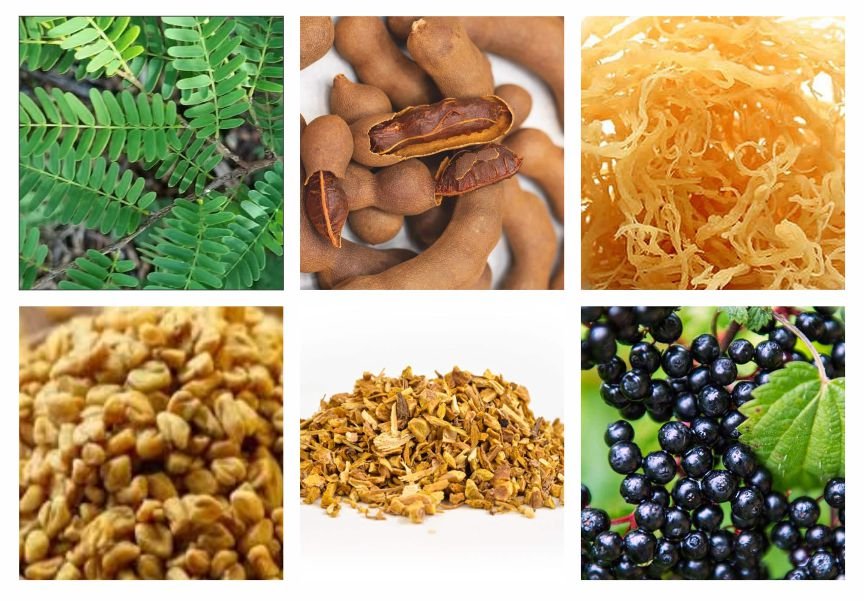
This site is built around six specific herbs, chosen for their place in West African households alongside their presence in the wider wellness conversation.
Three currently have complete libraries; three are still being written.
Moringa
Moringa is a fast-growing tree whose leaves, seeds, and pods are used across West Africa for both food and traditional remedies.
It’s one of the more nutrient-dense plants commonly discussed in herbal wellness content, valued for its vitamin, mineral, and protein content across multiple parts of the plant.
Our complete moringa guide covers nutrition, dosage by form, and safety notes for pregnancy, children, and specific health conditions. Read the complete guide to moringa here.
Tamarind
Tamarind is a tropical tree that produces tangy, fibrous pods used in cooking, drinks, and traditional digestive remedies throughout West Africa and South Asia.
Its pulp, seeds, leaves, and root each carry their own distinct traditional uses, and its role in digestion has drawn notable clinical research interest in recent years.
Our complete tamarind guide covers the fruit, seeds, leaves, and root in depth, along with research on digestion and blood sugar.
Fenugreek
Fenugreek seeds and leaves are used in cooking and traditional remedies for digestion and blood sugar support across West Africa,
South Asia, and the Middle East. Its seeds carry a distinctive bitter flavor and are commonly ground into spice blends or steeped for tea, with moderate clinical research behind its blood sugar claims specifically.
Our full fenugreek guide is currently in progress, and this page will link to it once published.
Elderberry
Elderberry is a flowering shrub whose cooked berries are widely used for cold and flu support, backed by more clinical research than most herbs on this list.
Raw elderberries and several other parts of the plant contain compounds that are toxic unless properly cooked first, a detail worth knowing before preparing it yourself.
You can read cited research on elderberry in our guide on herbs for immunity support while the dedicated elderberry library is in progress.
Sea Moss
Sea moss is a red algae harvested from coastal waters and valued for its mineral content, including iodine, calcium, and magnesium.
It carries a long tradition of use in Irish and Caribbean coastal communities.
Much of what’s sold commercially as sea moss today is actually a different species than the one most articles describe, a distinction this site covers in full depth.
Our complete sea moss guide covers preparation, dosage, and how sea moss compares to other seaweeds.
Yellow Dock Root
Yellow dock root is a perennial plant whose root has a long history of traditional use for digestion and mild bowel support, particularly within European and North American folk herbalism.
Research specific to yellow dock root stays more limited than for more widely studied digestive herbs, and this site says so plainly rather than overstating what’s actually been tested.
Our full guide covering dosage and safety is currently in progress.
Guides That Cover Herbs More Broadly
Some questions apply across herbs rather than to just one. These guides sit alongside the herb-specific libraries above and pull from across the founding six, plus other commonly discussed herbs where relevant.
Herb Storage
How to store fresh and dried herbs covers practical storage methods that affect potency, shelf life, and safety regardless of which specific herb you’re working with.
Improper storage is one of the most common, least discussed reasons a truly effective herb underperforms once it actually reaches your kitchen or medicine cabinet.
Herbs and Immunity
Herbs for immunity support reviews elderberry and moringa from the founding six alongside echinacea, astragalus, and garlic, evaluating the research behind each honestly rather than treating immune support as one interchangeable category.
Evidence quality varies substantially between these herbs, and this guide says so directly.
Herbs and Digestion
Herbs for digestion covers tamarind and fenugreek from the founding six in depth, alongside ginger, peppermint, and fennel, three herbs commonly used for bloating and general digestive discomfort.
Each is evaluated on its own evidence rather than grouped under a single vague digestive-support claim.
Herbs and Detox
Herbs for detoxification covers yellow dock root from the founding six alongside dandelion root and milk thistle, two herbs commonly discussed for liver and kidney support.
This guide also examines directly what “detox” claims can and can’t actually mean, since the term gets used loosely across the wellness space.
Herbs and Energy
Natural herbs for boosting energy covers moringa, sea moss, and fenugreek from the founding six alongside ginseng, rhodiola, and maca root, herbs traditionally used for stamina and vitality.
The guide separates mineral-driven energy support from herbs studied more directly for fatigue and performance.
Choosing the Right Herbs
How to choose the right herbs walks through matching an herb to a specific health goal rather than a trend, plus safety, sourcing, dosage, and interaction considerations that apply regardless of which herb you’re evaluating. It’s the most detailed safety and selection guide on the site.
Conclusion
Herbs aren’t a rejection of modern medicine, and modern medicine isn’t a replacement for the accumulated knowledge behind traditional herb use.
The two share a history closer than most discussions admit, with a meaningful share of today’s pharmaceuticals tracing directly back to plant compounds identified long before clinical trials existed.
What’s changed is precision and proof, not the underlying value of the plants themselves.
This site’s job is to keep both threads honest: what tradition supports, what research confirms, and where the two actually still disagree.
Frequently Asked Questions
Do people still rely on herbal medicine today?
Yes, the World Health Organization estimates that more than 80 percent of the population across most of its member states uses some form of traditional medicine, herbs included.
Did modern medicine really come from herbs?
Largely, yes. Aspirin, morphine, quinine, digoxin, and several cancer treatments were all originally identified in plants before being isolated and standardized.
Should I choose herbs instead of prescribed medication?
Not necessarily. Herbs and conventional medicine serve different roles, and switching away from prescribed treatment without medical guidance can be truly risky.
Which herbs does this site cover?
Moringa, tamarind, fenugreek, elderberry, sea moss, and yellow dock root, alongside cross-herb guides on storage, immunity, digestion, detoxification, energy, and choosing the right herb.