
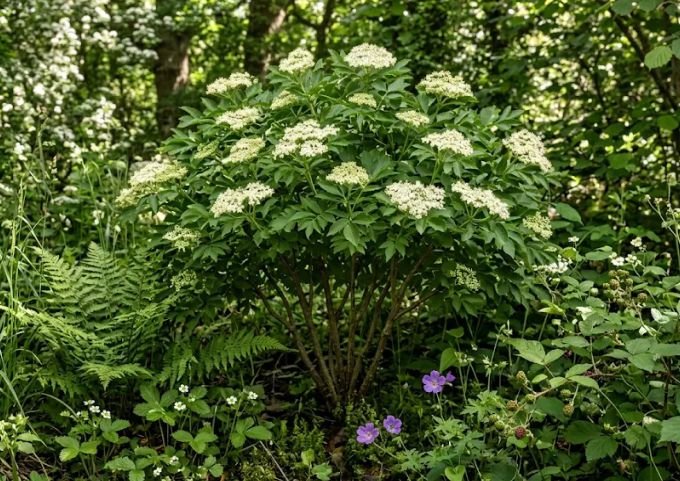
A single American elder cluster can hold several hundred tiny white flowers, yet deadly plants also carry flat white blooms. Knowing how to identify elderberry by leaves, stems and fruit protects every forager before the first berry reaches a basket.
My work with plants and traditional agriculture across Eastern Nigeria began in 2010, yet elder has never grown in our Aba compound.
Every feature below comes from US Forest Service, university extension and state conservation sources rather than my own walks.
This article explains how to identify elderberry through each season, from bare winter twigs to summer flowers and autumn fruit.
It also compares American, European, blue and red elders, and lists the checks to run before you harvest anything at all.
Readers wanting the wider picture of this shrub can open our elder shrub overview first, then return here.
Safety note: never eat any part of a plant you cannot identify with certainty, since some elder lookalikes are deadly poisonous.
Always consult your personal healthcare provider before adding new supplements to your routine, especially if you are pregnant, nursing, or taking prescription medications.
Table of Contents
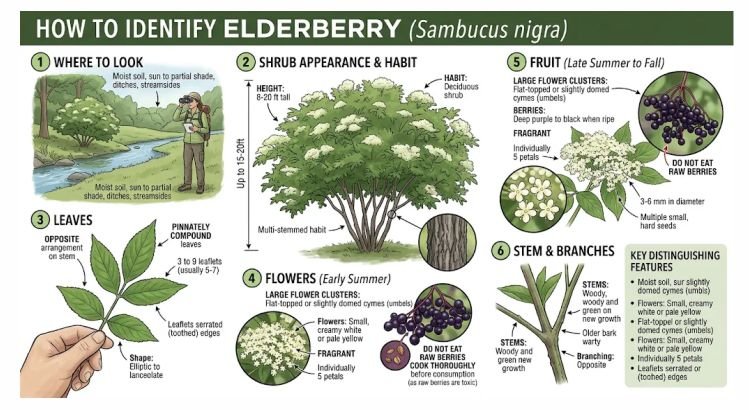
The Quick Field Checklist
Several features together confirm elder, so never rely on flowers or berries alone.
| Feature | What American elder shows | Source |
|---|---|---|
| Growth form | Multi-stemmed woody shrub, 5 to 12 feet tall | NC State Extension |
| Leaves | Opposite, pinnately compound, usually 7 leaflets | NC State Extension |
| Leaflet edges | Sharply serrated | NC State Extension |
| Bark | Grayish, smooth, warty with lenticels | NC State Extension |
| Pith | White in young stems | NC State Extension, USDA Forest Service |
| Flowers | Flat-topped creamy clusters, 4 to 10 inches across | NC State Extension |
| Fruit | Drooping clusters of purple-black berries, about 1/4 inch | NC State Extension |
A plant that fails any one of these checks deserves a second look before anyone handles its fruit.
How to Identify Elderberry by Its Leaves
Leaves are present from spring to autumn, which makes them the most reliable feature for most of the year.
Arrangement
The NC State Extension plant profile describes elder leaves as opposite and pinnately compound.
Opposite means leaves grow in pairs across from each other on the stem, never staggered one by one.
Leaflet Count
NC State counts usually 7 leaflets per leaf, within a range of 5 to 11, including one at the tip.
Virginia Tech’s dendrology fact sheet adds that the lowest leaflets are frequently three-lobed.
Leaflet Outline and Edges
Leaflets are oval to lance-like in outline, with sharply serrated margins, and the whole leaf runs 6 to 11 inches long.
Virginia Tech notes a dark green upper surface and a much paler underside.
Stems, Bark and Pith
Stems are the best feature in winter, when leaves, flowers and fruit have all gone.
Bark and Twigs
NC State describes yellowish-gray to light grayish-brown bark that looks warty from scattered lenticels.
Virginia Tech calls the twigs stout and silvery to yellow-gray, with very small red-brown buds and usually no buds at the tip.
The Pith Test
Snap or cut a young stem, and American elder shows a large white pith in the center.
The USDA Forest Service plant profile adds that older stems are mostly hollow.
Growth Form
Elder grows as a multi-stemmed shrub with arching canes, usually wider than tall, and it can sucker into thickets.
Those canes are also how gardeners start new plants, as covered in rooting elder from cuttings.
Flowers
Flowering is the season when mistakes happen most, because many plants carry white clusters at the same time.
The Forest Service says American elder flowers from June to July, depending on region.
- NC State describes creamy-white flowers about 1/4 inch wide, packed into flat-topped to rounded clusters.
- Those clusters span 4 to 10 inches across, and the Forest Service says each may hold several hundred flowers.
- The clusters sit at the branch tips, on wood that grew the previous year.
Flower picking for drinks is covered in making cordial from blossoms, including when to harvest.
Berries
Ripe fruit is the easiest feature to recognize, though color alone never confirms the plant.
- NC State describes rounded, purplish-black berries about 1/4 inch across, each with 3 to 5 small stones.
- The clusters droop under their weight and appear from August to September in North Carolina.
- Unripe berries are green, and NC State notes they are much more toxic than ripe fruit.
Knowing when clusters are ready to pick is the subject of the ripeness and harvest guide.
Telling the Elder Species Apart
Several elders grow in North America and Europe, and knowing how to identify elderberry species matters for both flavor and safety.
| Elder | Where it grows | Flower clusters | Ripe fruit |
|---|---|---|---|
| American elder, S. nigra ssp. canadensis | Much of the eastern and central US and Canada | Flat-topped, early summer | Purple-black |
| European elder, S. nigra ssp. nigra | Europe and western Asia | Flat-topped | Purple-black |
| Blue elder, S. nigra ssp. cerulea | Western US, British Columbia and parts of Mexico | Flat-topped | Dark; check a regional guide |
| Red elder, S. racemosa | Parts of North America | Egg-like or pyramidal, spring | Red |
The subspecies ranges in this table come from the Forest Service profile, while red elder details come from Missouri.
The differences between the two black-fruited elders are compared in the black elder comparison.
Spotting Red Elder
The Missouri Department of Conservation field guide describes red elder flowers in dense, egg-like or pyramidal clusters 2 to 4 inches long.
It flowers in April and May, earlier than American elder, and its red berries ripen from June to August.
Its pith is brown rather than white, which gives a reliable stem test in any season.
Missouri advises against eating red elder fruit, and Oregon State Extension warns that red berries can hold more toxin than dark ones.
Dangerous Lookalikes
Several poisonous plants share at least one elder feature, so a full checklist beats any single clue.
A UF/IFAS Extension article contrasts elder, a woody shrub, with water hemlock, whose main stem is hollow and whose leaves alternate.
The author describes water hemlock as deadly in every part, with the roots most dangerous of all.
Virginia Tech also lists green ash and boxelder as trees whose compound leaves resemble elder.
A plant-by-plant comparison of every common risk appears in poisonous plants resembling elder.
Before You Harvest
Knowing how to identify elderberry is the first step, and safe handling follows straight after it.
- Confirm opposite compound leaves, warty bark, white pith and the right flower or fruit form together.
- Check that the plant has not been sprayed, and avoid shrubs along busy roads.
- Leave stems and leaves behind, because those parts hold more of the toxic compounds than the berries.
Even correctly identified berries need cooking, as explained in cooking elderberries before eating.
Always consult your personal healthcare provider before adding new supplements to your routine, especially if you are pregnant, nursing, or taking prescription medications.
Conclusion
Learning how to identify elderberry means checking several features together, never relying on flowers or fruit alone.
Look for opposite compound leaves, warty bark, white pith, flat white flower clusters and drooping purple-black berries.
Red elder has pyramidal spring clusters, red summer fruit and brown pith, and its berries should not be eaten.
When any single feature does not match the checklist, leave the plant alone and look elsewhere.
Six Herbs has a full elder series, so read the lookalikes guide next to sharpen your eye before foraging this season.
Frequently Asked Questions
What does an elderberry bush look like?
It is a multi-stemmed shrub with opposite compound leaves, flat white flower clusters and drooping dark berries.
Snap a young stem open, and you will find white pith inside it.
How do you identify elderberry in winter?
In winter, look for opposite buds, warty gray bark and large white pith inside young stems.
Older stems are mostly hollow, according to the USDA Forest Service profile.
How can you tell red elderberry apart?
Red elder has pyramidal spring flower clusters, red summer berries and brown rather than white pith.
The Missouri Department of Conservation advises against eating its fruit at all.
Is it hard to learn how to identify elderberry?
It takes practice, since lookalikes share single features, so confirm several features together before picking.
Ask a local extension office or experienced forager whenever any doubt remains.
Disclaimer: Six Herbs is an educational resource, not a medical service. Nothing in this article constitutes medical advice, diagnosis, or treatment. Always consult a qualified healthcare provider before using any herb medicinally, particularly if you are pregnant, breastfeeding, taking medication, or managing a health condition.

Chims Clements writes about herbs from personal experience and careful research. Growing up in Aba, Nigeria, moringa and tamarind were everyday household plants long before they became globally recognised superfoods. He uses both regularly in his home today. At Six Herbs he goes deep on moringa, tamarind, fenugreek, and sea moss — building honest, experience-backed content that separates what tradition knows from what science confirms. The content on this site is for informational purposes only and is not medical advice. Always consult a healthcare provider before using herbs medicinally.