
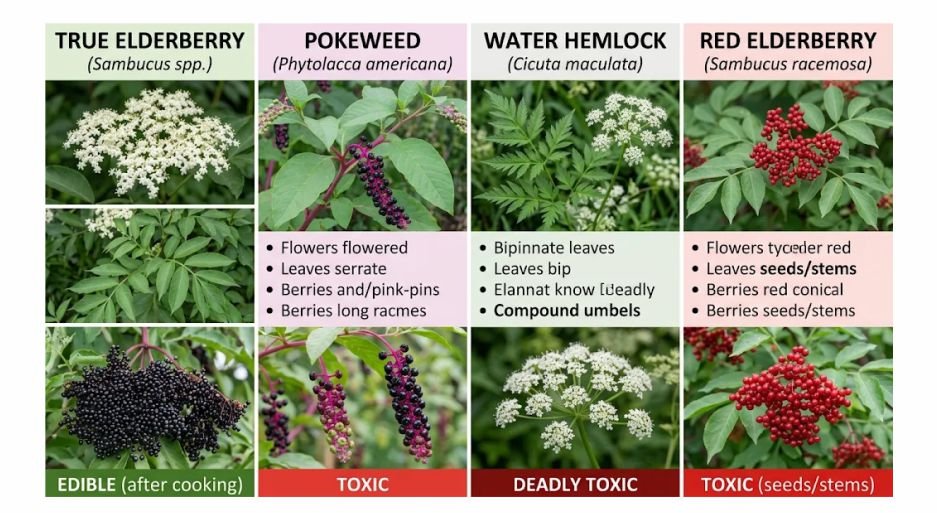
Washington State University calls western water hemlock one of the most poisonous plants in North America, with no known treatment. It also carries umbrella-like clusters of tiny white flowers, which is why elderberry look-alikes deserve a careful second look.
In Eastern Nigeria, uziza and utazi are gathered by people who know each plant on sight, and that standard suits elder perfectly.
Elder does not grow where I live, so every identification detail comes from extension and conservation agencies in four American states.
Six elderberry look-alikes get a short profile each, followed by a side-by-side table and a set of field tests.
Two are deadly, two carry toxic berries, one is an inedible elder relative and one is a confusing but harmless weed.
Anyone still learning the shrub can keep the Six Herbs elder hub open alongside these profiles.
Safety note: water hemlock and poison hemlock can kill, so never taste, crush or harvest a plant until every elder feature checks out.
Always consult your personal healthcare provider before adding new supplements to your routine, especially if you are pregnant, nursing, or taking prescription medications.
Table of Contents
Four Questions to Ask at the Shrub
Most mistakes happen when a forager checks one feature and stops, so ask all four of these first.
- Is the plant woody, with bark and branches that last through winter, or is it a soft green stem?
- Are the leaves opposite, growing in pairs, and divided into toothed leaflets?
- Does a young stem show a solid white pith when you snap or cut it open?
- Are the flowers in a flat-topped cluster, or the berries in a drooping, dark cluster?
A full feature-by-feature walkthrough of true elder appears in elder identification by season.
The Six Elderberry Look-Alikes
Each profile below names the feature most likely to fool a forager and the feature that gives the impostor away.
Water Hemlock
WSU’s Hortsense fact sheet describes white umbrella-like flower clusters, but on a hollow, non-woody stem with alternate leaves. It grows in wet ground along streams and ditches, and WSU calls it extremely poisonous, with no known treatment.
Poison Hemlock
Its white flower clusters resemble elder blossoms from a distance, yet the leaves are finely divided and fern-like. MU Extension’s June 2026 warning describes smooth hollow stems with purple blotches and says every part is poisonous.
Pokeweed
Pokeweed fools berry pickers with juicy, purple-black fruit, but those berries hang on long reddish stalks rather than flat clusters. Penn State Extension’s pokeweed page says its berries, roots and new leaves are toxic, and its stems are not woody.
Devil’s Walking Stick
This shrub carries large compound leaves and heavy clusters of purple berries in fall, much like elder. The University of Arkansas plant profile points to quarter-inch prickles covering its stems, a feature elder never has.
Red Elder
Red elder is a true elder with opposite compound leaves, so leaf checks alone will not separate it. Missouri conservation staff note its spring flower clusters form pyramids, its berries ripen red and its stems hold brown pith.
Queen Anne’s Lace
This roadside weed has lacy white flower clusters on a hollow stem, and MU Extension says it is not toxic. The danger lies in confusing it with poison hemlock, since a forager unsure of one plant may misjudge both.
Side-by-Side Comparison
The table pulls the key features together, using the same extension sources cited in each profile above.
| Plant | Woody? | Leaves | Flowers or fruit | Main giveaway | Risk |
|---|---|---|---|---|---|
| Elder, the true target | Yes | Opposite, compound, toothed | Flat white clusters, drooping dark berries | White pith in young stems | Cook berries before eating |
| Water hemlock | No | Alternate, compound | White umbrella clusters | Hollow stem, wet ground, chambered root | Deadly |
| Poison hemlock | No | Fern-like, finely divided | White umbrella clusters | Purple-blotched hollow stem | Deadly |
| Pokeweed | No | Alternate | Dark berries on long reddish stalks | Reddish, non-woody stems | Toxic berries and roots |
| Devil’s walking stick | Yes | Very large, twice or thrice compound | Purple berry clusters in fall | Prickly stems | Avoid |
| Red elder | Yes | Opposite, compound | Pyramidal clusters, red berries | Brown pith, spring bloom | Do not eat berries |
| Queen Anne’s lace | No | Finely divided | Lacy white clusters | Usually under 2 feet tall | Not toxic, but easily confused |
Field Tests That Separate Elder From Impostors
With elderberry look-alikes, physical checks work better than photos, because color and light change how any plant looks on a screen.
The Bark Test
Elder is a woody shrub that keeps its bark and branches through winter, while both hemlocks and pokeweed die back.
The Leaf Pair Test
Elder leaves come in matched pairs across the stem, whereas water hemlock and pokeweed leaves alternate along it.
The Vein Test for Water Hemlock
WSU notes that water hemlock leaflet veins end in the notches between teeth, rather than at the tooth tips.
Use this only as a confirming detail, and never handle a suspected hemlock with bare hands.
The Pith and Prickle Test
Snap a young elder stem to see white pith, and check the bark for prickles that would point to devil’s walking stick.
Red elder fails the pith test with its brown center, one of several traits covered in how the elder species differ.
When Flowers Are the Only Clue
Early summer is the riskiest time, because elder, both hemlocks and Queen Anne’s lace can all bloom white together.
Flower foragers making drinks need extra care, so the cordial method in picking blossoms for cordial starts with plant checks.
- Check that the flowers grow on a woody shrub, not on a soft herbaceous stalk.
- Look at the leaves below the flowers, since fern-like foliage rules out elder at once.
- Wear gloves near any umbrella-flowered plant, because MU warns that poison hemlock sap can blister skin.
When Berries Are the Only Clue
Late summer brings dark fruit on elder, pokeweed and devil’s walking stick within the same few weeks.
Ripe elderberries come in broad, drooping clusters, while pokeweed berries line long, narrow stalks.
Even correctly identified elder fruit needs cooking first, as covered in why berries must be heated.
The right picking window for true elder is set out in elder harvest timing.
Safer Ways to Source Elderberries
Telling apart elderberry look-alikes takes practice, and some readers may prefer to skip wild picking altogether.
- Plant a named cultivar from a nursery, then grow more using propagating elder from canes.
- Buy dried berries from a supplier that lists the species and origin on every package.
- Join a local extension or foraging walk, where an experienced guide can confirm plants in person.
If anyone eats a plant you suspect is hemlock or pokeweed, phone the national Poison Help line, 1-800-222-1222, straight away.
Always consult your personal healthcare provider before adding new supplements to your routine, especially if you are pregnant, nursing, or taking prescription medications.
Conclusion
Elderberry look-alikes range from deadly water hemlock and poison hemlock to toxic pokeweed and prickly devil’s walking stick.
Red elder looks right in leaf but carries red fruit and brown pith, while harmless Queen Anne’s lace mainly causes confusion.
True elder is woody, with opposite toothed leaflets, white pith and flat flower clusters.
Check every feature together, wear gloves near umbrella-flowered plants and walk away whenever any doubt remains.
Six Herbs covers elder from shrub to kitchen, so bookmark the identification guide and review it before each foraging trip.
Frequently Asked Questions
Which plant is most commonly mistaken for elderberry?
Water hemlock and poison hemlock are the riskiest mix-ups, since their white flower clusters resemble elder blossoms.
Both are soft-stemmed herbaceous plants, while true elder is a woody shrub.
How do you tell elderberry from pokeweed?
Elder berries hang in broad drooping clusters on a woody shrub, while pokeweed berries line long reddish stalks.
Penn State Extension lists pokeweed berries, roots and young leaves as toxic.
Are any elderberry look-alikes safe to eat?
MU Extension says Queen Anne’s lace is not toxic, yet mistaking hemlock for it can be deadly.
Treat any plant you cannot fully identify as poisonous, and leave it alone.
What should I do if someone eats a suspected lookalike?
Phone the Poison Help line, 1-800-222-1222, or emergency services if the person has seizures or trouble breathing.
Keep a sample of the plant so experts can identify it quickly.
Disclaimer: Six Herbs is an educational resource, not a medical service. Nothing in this article constitutes medical advice, diagnosis, or treatment. Always consult a qualified healthcare provider before using any herb medicinally, particularly if you are pregnant, breastfeeding, taking medication, or managing a health condition.

Chims Clements writes about herbs from personal experience and careful research. Growing up in Aba, Nigeria, moringa and tamarind were everyday household plants long before they became globally recognised superfoods. He uses both regularly in his home today. At Six Herbs he goes deep on moringa, tamarind, fenugreek, and sea moss — building honest, experience-backed content that separates what tradition knows from what science confirms. The content on this site is for informational purposes only and is not medical advice. Always consult a healthcare provider before using herbs medicinally.