
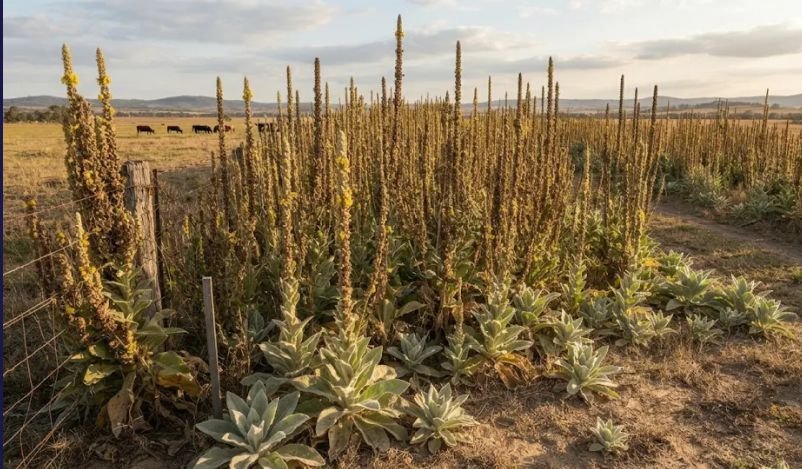
Colorado’s noxious weed program files mullein under List C, reserved for species too widespread to wipe out statewide. That single listing shows why asking if mullein is invasive gets different answers depending on region, habitat and whichever local weed laws apply.
Mullein lines roadsides across North America and Australia, so many people assume it is a damaging invader.
Its herbal reputation sits awkwardly beside its listing as a noxious weed in some places.
Weeding comes with any farm work, including mine around Eastern Nigeria, yet mullein has never been among the plants I pulled.
Weed boards, extension services and Australia’s national weed information site supply the evidence used here.
The honest answer to is mullein invasive turns out to be more nuanced than a simple yes or no.
Basic botany, history and uses are gathered in the Six Herbs mullein introduction.
Safety note: weed rules carry legal weight in some regions, so check locally, and ask a doctor before any medicinal use of mullein.
Always consult your personal healthcare provider before adding new supplements to your routine, especially if you are pregnant, nursing, or taking prescription medications.
Table of Contents
The Short Answer by Region
The table summarizes how the answer to whether mullein is invasive changes across regions and legal systems.
| Region | Status | Source |
|---|---|---|
| Colorado, USA | List C noxious weed, too widespread to eradicate statewide | Colorado Dept. of Agriculture |
| California, USA | On CalEPPC’s older List B; a local problem, mainly in the eastern Sierra Nevada | Cal-IPC |
| North Carolina, USA | Garden Verbascum flagged as invasive | NC State Extension |
| Wisconsin, USA | Not considered an aggressive weed | UW-Madison |
| Victoria, Australia | Declared weed | Weeds Australia |
| Rest of Australia | Present but not declared, and not a Weed of National Significance | Weeds Australia |
| Britain and Ireland | Native wildflower | RHS |
Why Mullein Spreads So Easily
Colorado’s common mullein fact sheet credits each plant with 100,000 to 250,000 seeds, borne in numerous two-chambered fruits.
Australia’s national mullein profile notes that seeds readily contaminate soil and farm produce and move with wind, water or animals.
Even so, most seeds land close to home, with Cal-IPC’s mullein assessment putting about 75 percent within one meter of the parent.
Some seeds travel farther, up to roughly 11 meters, the same report adds.
Buried seed stays alive for decades, so disturbed soil can sprout seedlings long after the parent plants vanish.
Construction and soil moving can carry that seedbank to new sites, Cal-IPC suggests.
Where It Causes Trouble
Cal-IPC says common mullein is rarely a serious weed of wildlands, since grasses and other plants usually crowd it out.
The exception is California’s eastern Sierra Nevada, where it thrives in sparsely vegetated soils.
Near Mono Lake and Owens Valley, it has invaded undisturbed moist meadows and displaced native herbs and grasses.
After western Sierra wildfires, dense rosettes can block native herbs and grasses from returning, the report notes.
Weeds Australia warns that high-density populations can alter plant community structure in grasslands.
In pastures, it can replace a considerable amount of forage and potentially reduce carrying capacity, the same profile says.
Livestock avoid it, since the dense hairs irritate their skin and mouths.
Where It Is Mostly Harmless
UW-Madison’s weed article on mullein calls it generally not an aggressive weed species in Wisconsin.
It is rarely a problem in gardens and tidy yards, the article adds, because its seeds need open ground.
Mullein is intolerant of shade and easily outcompeted by other plants and crops.
Populations fade on undisturbed sites, then return when soil is disturbed again.
In settled gardens, then, is mullein invasive is a question with a mostly reassuring answer.
In Britain and Ireland, the RHS great mullein profile lists it as a native plant, so it belongs to the local flora rather than invading it.
What the Laws Say
Colorado’s List C covers species that are widespread and well established, making statewide eradication impractical, according to Colorado’s noxious weed categories.
By contrast, List A species require mandatory eradication, and List B species must be managed to stop their spread.
Among Australian states, only Victoria lists great mullein as a declared weed, Weeds Australia reports.
Nationally, it is not a Weed of National Significance and does not appear on Australia’s alert or sleeper lists.
NC State Extension also tags garden Verbascum with an invasive warning for North Carolina because it self-seeds so freely.
Rules change and vary by county, so local weed boards remain the final word.
History of the Spread
UW-Madison writes that mullein was probably introduced to North America several times as a medicinal herb.
It was used in Virginia as a fish poison in the mid-1700s, the same article notes.
By 1818 it was described as native on the East Coast, reaching the Midwest by 1839 and the Pacific Coast by 1876.
In Australia, Weeds Australia traces it to nursery catalogues of 1845 and 1855, with naturalization in Victoria by 1887.
Range and habitat details for each continent sit in mullein’s global range.
How Worried Should You Be?
For most gardeners, whether mullein is invasive matters less than keeping a few plants from seeding into neighboring land.
- Gardeners: cut flower spikes before seed ripens if you grow mullein near pasture or wild land.
- Landowners: keep ground covered with dense vegetation, which UW-Madison says prevents seeds from germinating.
- Foragers: take leaves from established stands and avoid carrying ripe seed heads to new ground.
- Seed savers: check local weed lists before sowing, swapping or posting any seed.
Control methods, from hand-pulling to hoeing below the crown, are set out in getting rid of mullein.
Growers who want a tidy, contained patch can follow the steps in responsible mullein growing.
Bagging seed heads before cutting is described in collecting seed without scattering it.
Always consult your personal healthcare provider before adding new supplements to your routine, especially if you are pregnant, nursing, or taking prescription medications.
Other Disturbed-Ground Herbs
Like mullein, yellow dock thrives on disturbed ground, a habit introduced in yellow dock in the wild.
Wild plant safety for elderberry, including its lookalikes, sits in elderberry lookalikes to avoid.
Conclusion
Mullein is a noxious weed in Colorado and a declared weed in Victoria, in south-eastern Australia.
Cal-IPC sees it as a local problem in the eastern Sierra Nevada, while Wisconsin experts consider it fairly mild.
In Britain and Ireland, by contrast, it is simply a native wildflower of dry, grassy ground.
So the answer to whether mullein is invasive depends on where you live and how disturbed your land is.
Check local weed rules, ask a physician about medicinal use first, and read on for the next post, on mullein removal.
Frequently Asked Questions
Is mullein invasive in the United States?
It depends on the state, since Colorado ranks mullein among its List C noxious weeds. Cal-IPC treats it as a local problem, chiefly in the eastern Sierra range.
Is mullein native to the UK?
Yes, the RHS lists great mullein as native to Great Britain and Ireland. The Wildlife Trusts call it widespread, growing on waste ground, verges, gardens and dry grassland.
Does mullein spread by roots?
No, mullein spreads by seed alone, with no creeping roots, says Weeds Australia. Most seeds drop near the parent plant, though they can persist in soil for decades.
Is mullein bad for pastures?
Weeds Australia says dense stands can replace a considerable amount of pasture and reduce carrying capacity. Livestock generally avoid it because the hairs irritate their skin and mouths.
Disclaimer: Six Herbs is an educational resource, not a medical service. Nothing in this article constitutes medical advice, diagnosis, or treatment. Always consult a qualified healthcare provider before using any herb medicinally, particularly if you are pregnant, breastfeeding, taking medication, or managing a health condition.

Chims Clements writes about herbs from personal experience and careful research. Growing up in Aba, Nigeria, moringa and tamarind were everyday household plants long before they became globally recognised superfoods. He uses both regularly in his home today. At Six Herbs he goes deep on moringa, tamarind, fenugreek, and sea moss — building honest, experience-backed content that separates what tradition knows from what science confirms. The content on this site is for informational purposes only and is not medical advice. Always consult a healthcare provider before using herbs medicinally.