
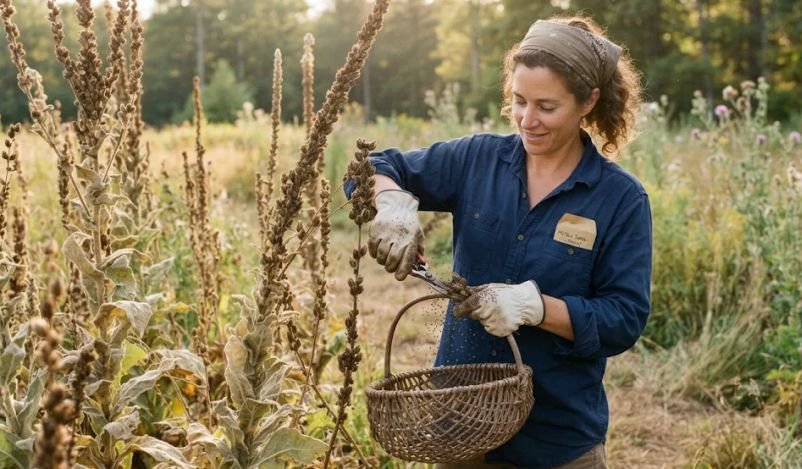
Buried mullein seed can remain viable for over a century, US Forest Service research reports, so every capsule deserves careful handling. That remarkable persistence explains why knowing how to collect mullein seeds tidily matters for gardeners and land managers alike.
Mullein makes seed in staggering amounts, and a single dry stalk can supply a garden for years.
Collected seed can start a home patch, fill a seed swap or simply stay out of the neighbor’s lawn.
Mullein capsules are something I know only from extension guides and weed surveys, not from my own harvests.
Iowa State and Oregon State supply the seed-saving method, while weed specialists describe mullein’s capsules and spread.
Learning how to collect mullein seeds also keeps unwanted seedlings out of nearby fields.
The plant’s wider story, from leaves to legends, is told in the mullein knowledge base.
Safety note: mullein seeds should never go into tea or food, so keep them labeled and away from children, and ask a doctor before medicinal use.
Always consult your personal healthcare provider before adding new supplements to your routine, especially if you are pregnant, nursing, or taking prescription medications.
Table of Contents
When Mullein Seed Is Ready
Mullein seed forms in second-year plants after the summer flowers fade along the spike.
Ohio State’s capsule description gives round, downy capsules roughly 1/4 inch wide, each dividing into two cells packed with tiny seeds.
Those seeds are tiny and dark brown, with wavy ridges, Ohio State adds.
Oregon State’s seed collecting guide advises gathering biennial seed heads once they are quite dry, taking plump seed before it falls.
For mullein, that means waiting until capsules turn brown and papery and the stalk rattles when shaken.
Blooming stretches across several weeks, so lower capsules likely ripen before the top ones, an inference worth checking on each stalk.
Good timing is the very first step in collecting mullein seed without scattering it everywhere.
Bloom timing by region, which sets the seed calendar, is covered in mullein’s flowering months.
What You Need
- Paper bags: large enough to slip over a seed spike, since paper lets moisture escape.
- Pruners or a sharp knife: for cutting the stalk just below the capsules.
- Gloves: the woolly stalks and leaves can irritate sensitive skin during handling.
- A fine sieve or colander: for separating tiny seeds from capsule fragments.
- Envelopes, jars and labels: for drying, storing and naming each batch you save.
Collecting the Seed
- Choose a dry day following a spell without rain, so capsules and seeds are not damp.
- Slip a paper bag over the top of the spike and tie it loosely around the stem.
- Cut the stalk below the bag, keeping the spike upright so seed stays inside.
- Tip the stalk upside down inside the bag and shake it to release loose seed.
- Hang the bagged stalk in a warm, ventilated room until every capsule is completely dry.
Oregon State recommends drying seed pods in a well-ventilated room at room temperature before removing seeds.
Mullein releases seed whenever the stalk is jostled, UW-Madison’s mullein biology notes explain, so cut and move stalks gently.
Bagging spikes before cutting is the single most useful habit for a clean, mess-free seed harvest.
Cleaning the Seed
Iowa State’s seed storage advice recommends separating seed from chaff by threshing, shelling or screening through colanders and sieves.
Crush dry capsules gently over a tray, then shake the debris through a fine sieve to catch the tiny seeds.
Iowa State also suggests winnowing with a fan, which blows lighter chaff away from heavier seed.
Use only a gentle breeze, because Kansas State describes mullein seed as very small.
Repeat the sieving and winnowing until most of the capsule fragments are gone.
Watch for small grubs as well, because UW-Madison records weevils whose larvae grow within mullein capsules.
Oregon State suggests 24 to 30 hours in a freezer to control weevils in stored seed.
Drying and Storing
Iowa State calls thorough drying the most important step to successfully storing seeds.
Store dry seed in labeled envelopes inside sealed glass jars, which keep out moisture, mice and insects.
Iowa State suggests adding an equal amount of silica gel in a separate envelope, removing it after one to two weeks.
Oregon State offers a low-cost alternative, a small cloth bag of dry powdered milk under the packets.
Keep jars somewhere cool and dry, such as a closet, root cellar or refrigerator, as Iowa State advises.
Write the plant name, the collection site and the date on every single jar.
How Long the Seed Lasts
Mullein seed is unusually long-lived, with the Forest Service mullein account citing soil persistence beyond 100 years.
California researchers cited in Cal-IPC’s Verbascum summary report viability lasting anywhere from 35 years up to a century in buried seed.
Seed stored dry and cool should keep well, though no source here gives a shelf life for jarred mullein seed.
Oregon State’s paper towel test checks viability: roll 25 to 50 seeds in damp towels, seal them in a bag and check every two days.
Kansas State recorded about 80 percent germination in roughly two weeks, a useful benchmark for your test.
Iowa State suggests running that germination test about one month before planting time.
Sowing and Sharing Responsibly
Collecting mullein seed brings a clear duty to keep it from spreading into places where it is unwanted.
Colorado lists common mullein as a List C noxious weed on Colorado’s mullein weed page, and Victoria in Australia lists it as noxious too.
Confirm local rules before sowing, swapping or mailing seed, as mullein’s weed status worldwide explains.
Sowing instructions for your saved seed sit in planting mullein seed at home.
If the goal is fewer plants instead, mullein removal methods cover cutting stalks ahead of seed ripening.
Keep Seeds Out of Tea
Seeds and capsules do not belong in mullein tea, since EBSCO’s mullein research starter notes the seeds contain rotenone.
Store seed jars apart from dried tea leaves, clearly labeled, and out of children’s reach.
Clean leaf harvesting and drying are covered separately in drying mullein leaves well.
Always consult your personal healthcare provider before adding new supplements to your routine, especially if you are pregnant, nursing, or taking prescription medications.
Seed Saving for Other Herbs
Yellow dock seed is gathered from rusty brown stalks, a topic covered in harvesting yellow dock seed.
Moringa seeds come from long pods instead, and the moringa tree overview introduces that plant.
Conclusion
Mullein seed is ready when second-year capsules turn brown and dry and the stalk rattles when shaken.
Bag the spike before cutting, dry it in a ventilated room, then sieve and winnow the tiny seeds.
Store dry seed in labeled envelopes inside sealed jars, kept cool, and test their germination before sowing.
Careful mullein seed saving also means respecting local weed laws and keeping every seed well out of tea.
Seek medical guidance before using any part of mullein medicinally, and stay with Six Herbs for the upcoming mullein posts.
Frequently Asked Questions
How do you collect mullein seeds without making a mess?
Slip a paper bag over the dry spike, tie it loosely, then cut the stalk. Shake the stalk upside down inside the bag to catch the loose seed.
When are mullein seeds ready to harvest?
Seeds are ready once the second-year capsules turn fully brown and dry. Shaking a dormant stalk should produce a rattle of seeds, as one Minnesota newspaper writer describes.
How should mullein seeds be stored?
Keep dried seed in labeled envelopes inside sealed glass jars, stored somewhere cool and dry. Iowa State suggests silica gel packets for the first one to two weeks.
How long do mullein seeds stay viable?
Remarkably long, since Forest Service research reports seed surviving in the soil beyond a full century. Cal-IPC cites buried seed lasting 35 to 100 years in other studies.
Disclaimer: Six Herbs is an educational resource, not a medical service. Nothing in this article constitutes medical advice, diagnosis, or treatment. Always consult a qualified healthcare provider before using any herb medicinally, particularly if you are pregnant, breastfeeding, taking medication, or managing a health condition.

Chims Clements writes about herbs from personal experience and careful research. Growing up in Aba, Nigeria, moringa and tamarind were everyday household plants long before they became globally recognised superfoods. He uses both regularly in his home today. At Six Herbs he goes deep on moringa, tamarind, fenugreek, and sea moss — building honest, experience-backed content that separates what tradition knows from what science confirms. The content on this site is for informational purposes only and is not medical advice. Always consult a healthcare provider before using herbs medicinally.