
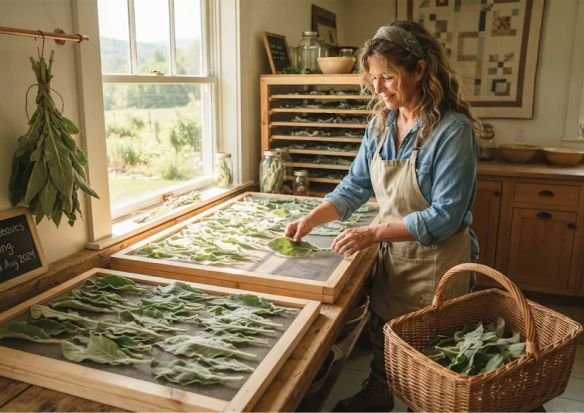
An Ask Extension expert expects mullein leaves laid flat in moving air to dry fully within about a week. That timeline, plus a dehydrator setting of 95 to 115 degrees Fahrenheit, frames how to dry mullein leaves without inviting mold.
Drying leaves is familiar work in my own household, because I dry and grind moringa leaves into powder myself.
Mullein brings a different challenge, with large, thick leaves wrapped in a woolly coat that holds on to moisture.
The steps here therefore lean on Penn State, Clemson and Kansas State extension advice rather than on any mullein batches of my own.
Learning how to dry mullein leaves well protects color, keeps mold away and gives noticeably better tea several months later.
Anyone starting from scratch can read up on the whole plant first through the mullein overview hub, then return.
Safety note: discard any mullein leaves that show mold, and ask a doctor before using dried mullein medicinally, especially when pregnant or nursing.
Always consult your personal healthcare provider before adding new supplements to your routine, especially if you are pregnant, nursing, or taking prescription medications.
Table of Contents
Before You Start Drying Mullein Leaves
Good drying begins at harvest, because wet, damaged or dusty leaves dry slowly and spoil faster.
The first rule of drying is starting with clean, dry foliage picked at the right moment.
The Kansas State mullein bulletin warns that these thick leaves must be dried completely, or mold can set in.
Pick after the dew lifts on a dry morning, using the timing in the mullein leaf harvest.
Penn State Extension’s herb drying guide advises removing bruised, soiled or imperfect leaves before drying anything.
If leaves need rinsing, Penn State suggests cool water, a gentle shake and patting dry to remove as much moisture as possible.
Unwashed leaves from clean sites dry faster, which is one more reason to avoid dusty roadside plants.
Drying Methods Compared
Several drying routes work for these thick leaves, and the table compares them using published extension figures.
| Method | Temperature | Typical time | Verdict for mullein | Source |
|---|---|---|---|---|
| One layer deep on a screen or clean surface | Room temperature, no direct sun | About a week | Best simple method | Ask Extension |
| Paper towels, up to five layers | Room temperature | Not stated | Works, change damp towels | Penn State |
| Paper bag with holes | Room temperature | Not stated | Good for small amounts | Penn State, Clemson |
| Food dehydrator | 95 to 115°F | About 1 to 4 hours for herbs | Fastest, most reliable | Clemson, Penn State |
| Oven on lowest setting | Not above 180°F | 3 to 4 hours, door open | Not recommended | Penn State |
| Sun drying | Outdoors | Varies | Not recommended | Penn State, Clemson |
Method One: Air Drying Flat
An Ask Extension answer recommends spreading harvested leaves one layer deep across a clean, dry surface.
The expert stresses circulating air and protection from direct sunlight, with drying complete within a week or so.
- Lay leaves flat on a mesh screen, cooling rack or clean towel, with no leaves overlapping.
- Place the screen in a dry, airy room, away from the sink, stove and dishwasher, as Penn State advises.
- Turn each leaf once a day so both woolly surfaces get airflow.
- Check thick midribs, since they hold moisture longest and dry well after the leaf blade.
- Stop once the leaves feel crisp and crumble easily between your fingers.
Speeding Up Thick Leaves
Tearing large, thick mullein leaves into halves or strips before drying should help them finish sooner.
This is a practical inference rather than a sourced rule, based on smaller pieces exposing more surface to moving air.
Penn State’s advice to dry large leaves separately, without touching, points the same way.
Method Two: Paper Towels or Paper Bags
Penn State describes drying large-leaved herbs between paper towels, stacking up to five layers at once.
Replace the towels as they absorb moisture, since damp paper slows drying and can encourage mold.
Paper bags punched with holes keep out dust while letting air move, a method both Penn State and Clemson describe.
Method Three: The Dehydrator
Clemson’s herb drying factsheet recommends preheating a dehydrator to 95 to 115°F, with up to 125°F in humid areas.
Penn State gives a slightly narrower range of 95 to 110°F for herbs.
Spread leaves one layer deep, keeping large leaves apart, and avoid drying them alongside fruit or vegetables.
Clemson lists about 1 to 4 hours for herbs, but mullein’s thickness will likely push it toward the longer end.
Check regularly until the leaves crumble and the midribs snap rather than bend.
Methods to Skip
Penn State calls oven drying generally not recommended, because even low heat destroys much of the flavor, oil and color.
Both extension services advise against sun drying, which can bleach leaves and lose flavor, especially in humid climates.
Penn State limits microwave drying to tender herbs such as parsley and basil and warns that paper towels can catch fire.
Drying Mullein Flowers
Flowers dry the same way as leaves, laid in a single layer with good airflow and no direct sun.
They are small and delicate, so they usually need far less time than the thick leaves.
Collect them on dry mornings as they open, using the timing in peak mullein bloom times.
Keep seed capsules out of any flower batch, since EBSCO’s mullein overview warns the seeds contain rotenone.
Checking for Dryness
Penn State and Clemson give the same test: leaves should be crispy and crumble easily between the fingers.
Clemson adds that stems should break when bent, which for mullein means the thick midrib should snap.
Any leathery or flexible patches mean more drying time, because Penn State notes herbs must be completely dry to prevent mold.
That crumble test is the simplest checkpoint in the whole process, and it matters more than any clock.
Storing Dried Mullein
- Let leaves cool completely before packing, since Clemson warns warm food can sweat and grow mold.
- Crumble or keep whole, remembering Penn State’s note that whole herbs hold flavor longer than crushed ones.
- Pack into airtight, vapor-proof containers such as glass jars with tight lids.
- Keep jars in a dark, dry cupboard well away from stoves, sinks and sunny windowsills.
- During the first week, look for droplets inside each jar, and re-dry any batch that shows them.
- Write the plant name and the drying date on every jar you fill.
Penn State says most dried herbs keep well for up to a year, while Clemson gives about four months to a year.
General jar and shelf habits for every herb are covered in shelf life of dried herbs.
Common Drying Problems
- Brown or black spots: usually overlapping leaves or poor airflow, so space leaves wider next time.
- Musty smell: a sign of mold, and the whole batch should be discarded.
- Leaves still bendy after a week: move them to a dehydrator to finish.
- Faded color: usually traced to direct sun or excessive heat during drying.
Using Your Dried Leaves
Once dry, crumble a teaspoon or two per cup and follow brewing tea from dried leaves.
Fine hairs remain on dried leaves, so straining stays as important as ever, as straining out the fuzz explains.
Drying slowly and gently also protects the mild, earthy notes described in mullein’s taste and aroma.
Drying Other Herbs on Six Herbs
Moringa leaves are far thinner and dry quickly, as drying moringa leaves at home shows.
Those dried moringa leaves can be ground into powder, a process explained in grinding moringa into powder.
Yellow dock root needs a different approach again, slicing and drying a dense root, as drying dock root slices describes.
Always consult your personal healthcare provider before adding new supplements to your routine, especially if you are pregnant, nursing, or taking prescription medications.
Conclusion
Mullein leaves dry best flat, in a single layer, with circulating air and no direct sun, usually within a week.
A dehydrator at 95 to 115°F finishes the job faster, especially in humid weather.
Finished leaves crumble at a touch, and the thick midribs snap cleanly, with no leathery patches left.
Good drying also means cooling the leaves fully, sealing the jars and storing them somewhere dark for up to a year.
Run any medicinal plans past a doctor first, and grow your mullein project steadily alongside Six Herbs.
Frequently Asked Questions
How many days do mullein leaves take to dry?
An Ask Extension expert expects air-dried leaves to finish within about a week. A dehydrator at 95 to 115°F is faster, though thick leaves take extra time.
Can you dry mullein leaves in the oven?
Penn State calls oven drying not recommended, because heat destroys flavor, oil and color. If you try it, keep the oven below 180°F with its door open.
How do you dry mullein leaves without a dehydrator?
Lay leaves flat on a screen or towel in moving air, away from direct sun. Turn the leaves once a day until they crumble easily between your fingers.
How long do dried mullein leaves last?
Penn State gives up to a year, while Clemson suggests four months to a year. Airtight jars kept in a dark, cool cupboard help them last the longest.
Disclaimer: Six Herbs is an educational resource, not a medical service. Nothing in this article constitutes medical advice, diagnosis, or treatment. Always consult a qualified healthcare provider before using any herb medicinally, particularly if you are pregnant, breastfeeding, taking medication, or managing a health condition.

Chims Clements writes about herbs from personal experience and careful research. Growing up in Aba, Nigeria, moringa and tamarind were everyday household plants long before they became globally recognised superfoods. He uses both regularly in his home today. At Six Herbs he goes deep on moringa, tamarind, fenugreek, and sea moss — building honest, experience-backed content that separates what tradition knows from what science confirms. The content on this site is for informational purposes only and is not medical advice. Always consult a healthcare provider before using herbs medicinally.