
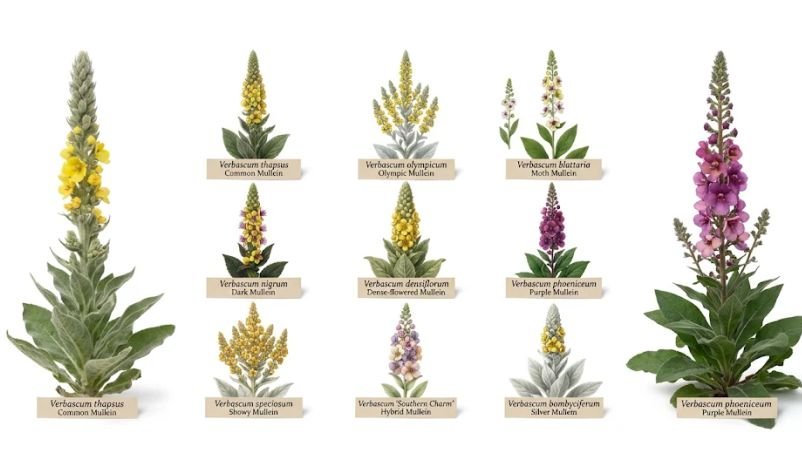
Kew’s Plants of the World Online puts the Verbascum genus at about 360 species, with its greatest Asian diversity in Turkey and Iran. Only a handful of those types of mullein plants turn up in gardens or along Western roadsides.
Most people picture common mullein, the tall yellow spike of roadsides, but the genus holds far more variety than that single familiar plant.
My grandmother Kanka’s plants still grow at the family home in Aba today, but no Verbascum has ever joined them.
Species and cultivar details here come from Kew, the Royal Horticultural Society, NC State Extension and British wildlife gardening experts.
Sorting the types of mullein plants matters for foragers, who want true common mullein, and for gardeners choosing tidy border perennials.
Common mullein itself gets fuller treatment in the main common mullein page, from botany to tea.
Safety note: not every Verbascum species shares common mullein’s research record, so ask a doctor before using any type medicinally.
Always consult your personal healthcare provider before adding new supplements to your routine, especially if you are pregnant, nursing, or taking prescription medications.
Table of Contents
The Verbascum Genus
Kew’s Verbascum genus page lists the genus as native from Europe to Mongolia and Sri Lanka, and from North Africa to Kenya and Arabia.
Flowers are usually yellow, rarely violet or purple, and leaves form a basal rosette, the same summary notes.
Most species are herbs with glandular or dense hairs, though a few grow as small shrubs.
NC State’s Verbascum genus profile describes mulleins as annuals, biennials or short-lived perennials with tall spikes and woolly rosettes.
NC State lists flower colors from gold and yellow to pink, lavender and white across garden types.
Wild Types Compared
The table compares the three wild mulleins most likely found in North America and Britain.
| Species | Common name | Key features | Source |
|---|---|---|---|
| Verbascum thapsus | Great or common mullein | Densely woolly leaves, yellow flowers, up to 2 m | Wildlife Gardening Forum, Ohio State |
| Verbascum blattaria | Moth mullein | Less hairy, slender, toothed leaves, looser flower spikes | Ohio State |
| Verbascum nigrum | Dark mullein | Rich yellow petals, dark maroon stamen hairs, up to 1 m in garden loam | Wildlife Gardening Forum |
Great Mullein
Great mullein, Verbascum thapsus, is the species behind almost every Six Herbs mullein post.
Britain’s Wildlife Gardening Forum calls it much the commonest of the native Verbascum species there.
The same forum counts five native Verbascum species in Britain and Ireland, two of them common.
Its very densely hairy leaves and spikes up to 2 m tall make it the easiest type to spot.
Full field marks for this species sit in telling great mullein apart.
Moth Mullein
Verbascum blattaria, known as moth mullein, is another biennial that Ohio State’s moth mullein notes compare directly with common mullein.
Its foliage is far less hairy and its build slimmer, with toothed leaf edges and flowers set loosely on the spike.
NC State shows Verbascum blattaria in its genus photos and flags the genus as invasive in North Carolina, noting that it self-seeds readily.
Because its leaves lack the thick felt of common mullein, foragers seeking that species should pass it by.
Dark Mullein
Dark mullein, Verbascum nigrum, carries rich yellow petals around a center of dark maroon, fluffy stamen hairs.
The Wildlife Gardening Forum notes it grows up to 1 m in garden loam and seeds abundantly.
In the wild it usually grows on dry, lime-rich soils, the same source adds.
Those purple-centered flowers make dark mullein easy to separate from great mullein, whose stamen hairs are yellow or white.
Garden Verbascum Cultivars
Gardeners grow ornamental mulleins for their tall spikes, and the RHS honors at least one with its Award of Garden Merit.
Verbascum ‘Gainsborough’ holds that award, with primrose-yellow spikes reaching 1 to 1.5 m above a gray-green rosette, per the RHS Gainsborough entry.
The RHS describes it as a short-lived perennial that prefers poor, alkaline, well-drained soil and full sun.
White nettle-leaved mullein, Verbascum chaixii ‘Album’, bears pure white flowers with purple stamens from June to August, according to the RHS listing for ‘Album’.
That cultivar reaches about 1 m and is hardy throughout the UK, rated H6 by the RHS.
NC State adds ‘Banana and Custard’, ‘Sixteen Candles’, ‘Wedding Candles’ and Snowy Spires, among others.
Sixteen Candles bears yellow blooms with violet centers, while Wedding Candles and Snowy Spires run white with purple centers.
NC State suggests these garden types for cottage, rock, cutting and drought-tolerant gardens.
Among cultivated garden mulleins, the color range runs far wider than the wild plants would suggest.
Growing Mullein Types at Home
Most garden mulleins share common mullein’s taste for sun and lean, well-drained soil, judging by RHS growing notes.
Sowing and care for common mullein itself are set out in raising mullein from seed.
Self-seeding is typical across the genus, so check mullein’s weed rules by region before planting near wild land.
Seed collection for any type follows the steps in saving Verbascum seed.
Bees visit garden types too, as NC State notes, and pollinators get fuller coverage in mullein and its pollinators.
Which Type Is Used for Tea?
Of all these wild and garden mulleins, common mullein is the species described in the tea and harvest sources used on Six Herbs.
The EU mullein flower monograph also covers flowers of two related species, Verbascum phlomoides and Verbascum densiflorum.
Garden cultivars are bred for looks, and none of the RHS or NC State pages reviewed here describe them as tea plants.
Brewing details for common mullein leaves live in the mullein tea method.
Always consult your personal healthcare provider before adding new supplements to your routine, especially if you are pregnant, nursing, or taking prescription medications.
Plant Families Across the Site
Yellow dock sits in the buckwheat family rather than the figwort family, and the yellow dock plant profile covers it in full.
Elderberry has its own species split, with the American and European plants weighed against each other in two elder species contrasted.
Conclusion
Kew places about 360 species in Verbascum, native from Europe across Asia and down into North Africa.
Great mullein is the common wild type, while moth and dark mullein add slimmer or purple-centered variations.
Garden cultivars such as ‘Gainsborough’ and chaixii ‘Album’ bring primrose, white and violet-eyed spikes to sunny borders.
Knowing the types of mullein plants keeps foragers on track with common mullein and helps gardeners choose wisely.
Confirm the species before picking, get medical clearance for medicinal use, then keep on browsing Six Herbs for more mullein topics.
Frequently Asked Questions
How many types of mullein plants are there?
Kew’s online plant database puts the Verbascum genus at about 360 species. Only a few, such as great, moth and dark mullein, are familiar in Britain or America.
How does moth mullein differ from common mullein?
Moth mullein is less hairy and slimmer, with toothed leaves and looser flower spikes. Common mullein has densely woolly leaves and tightly packed yellow flowers on its spike.
Are garden verbascums the same as mullein?
They belong to the same Verbascum genus, so gardeners also call them mulleins. Cultivars like ‘Gainsborough’ are short-lived perennials grown for their flowers rather than for leaf tea.
Which mullein has purple centers?
Wild dark mullein shows dark maroon stamen hairs inside rich yellow petals. Garden types such as ‘Sixteen Candles’, ‘Wedding Candles’ and chaixii ‘Album’ carry violet or purple centers.
Disclaimer: Six Herbs is an educational resource, not a medical service. Nothing in this article constitutes medical advice, diagnosis, or treatment. Always consult a qualified healthcare provider before using any herb medicinally, particularly if you are pregnant, breastfeeding, taking medication, or managing a health condition.

Chims Clements writes about herbs from personal experience and careful research. Growing up in Aba, Nigeria, moringa and tamarind were everyday household plants long before they became globally recognised superfoods. He uses both regularly in his home today. At Six Herbs he goes deep on moringa, tamarind, fenugreek, and sea moss — building honest, experience-backed content that separates what tradition knows from what science confirms. The content on this site is for informational purposes only and is not medical advice. Always consult a healthcare provider before using herbs medicinally.