
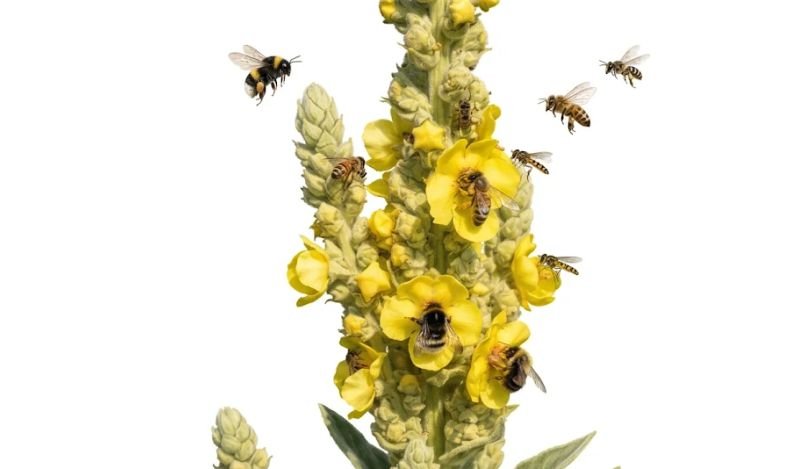
Britain’s Royal Horticultural Society counts 30 insects feeding on verbascums and lists every species and cultivar as a plant for pollinators. Great mullein, the tall roadside species, is singled out in that article as a magnet for bumblebees and honeybees.
Most writing on mullein stops at tea, yet the plant supports a small crowd of insects, birds and even nest-building bees.
Its flowers, leaves, stalks and seeds each serve a different visitor as the seasons turn.
Knowing who visits helps gardeners decide which plants to keep and when to cut their stalks.
Mullein’s insect life is known to me only through naturalists’ records, since I have yet to see the plant growing.
Details come from the RHS, Illinois Wildflowers, British moth recorders and a long-running bird blog.
Leaves, tea and history get their own treatment in the central mullein page.
Safety note: avoid spraying mullein that wildlife depends on, and ask a doctor before using any part of the plant medicinally.
Always consult your personal healthcare provider before adding new supplements to your routine, especially if you are pregnant, nursing, or taking prescription medications.
Table of Contents
Which Insects Visit the Flowers?
The RHS verbascum feature says the long-lasting, pollen-rich spikes draw bumblebees, honeybees, hoverflies and butterflies.
Illinois Wildflowers’ visitor notes name bumblebees as the most important pollinators, visiting for both nectar and pollen.
Smaller halictid bees and syrphid flies also gather pollen, the same page adds.
Only a few flowers open on each spike at once, so a single stalk feeds visitors for weeks rather than days.
A Minnesota mullein feature also mentions dragonflies and other insects drawn to the summer flowers.
Daily opening hours and regional bloom months are set out in mullein’s bloom calendar by region.
Does Mullein Need Pollinators?
Insects are helpful but not required, since Victoria’s weed archive records self-pollination whenever cross-pollination does not occur.
That backup helps explain how isolated roadside plants still set huge seed crops.
Mullein Moth Caterpillars
The mullein moth, Cucullia verbasci, relies largely on mullein, and its caterpillars feed on the felted rosette leaves at ground level, the RHS notes.
The Wildlife Trusts describe those caterpillars as spotted yellow and black, found from May to July.
Caterpillars feed by day and night, and their bold markings may warn predators that they taste bad, the RHS suggests.
UKMoths’ Mullein species account gives the adult a wingspan of 45 to 50 mm and a flight period of April to May.
The adult is camouflaged to resemble a plant stem, so it turns up far less than its larvae.
In wild settings the caterpillars use various mulleins, and in gardens they also feed on buddleia, UKMoths adds.
The RHS stresses that the caterpillars do not kill the plant, and a few nibbled leaves signal a garden that works for wildlife.
Wool Carder Bees and Mullein Hairs
The RHS notes that wool carder bees collect the white hairs from mullein leaves to line their nests.
Illinois Wildflowers makes the same observation, describing the fuzz as a waterproof lining.
Ohio State’s bee profile describes female wool carders scraping hairs from fuzzy leaves, especially lamb’s ear, to wall off egg cells.
Males guard patches of these fuzzy plants and body-slam intruders, though male bees cannot sting, the same profile notes.
Lamb’s ear and mullein share that felt, a likeness compared leaf by leaf in lamb’s ear versus mullein.
Seed Weevils and Other Insects
Some insects use mullein in ways that matter more to farmers than to gardeners.
UW-Madison’s mullein insect notes report a seed-feeding weevil, Gymnaetron tetron, accidentally introduced to Canada before 1937 and now widespread across North America.
Its grubs grow within the capsules and eat roughly half the seeds, by UW-Madison’s estimate.
Cal-IPC’s mullein ecology notes add that mullein is thought to host the mullein leaf bug, a pest of apples and pears in eastern North America.
Orchard growers may therefore prefer to clear nearby plants, using methods from clearing mullein near crops.
A Year of Visitors
Mullein’s visitors change with the seasons, and this calendar pulls the main ones together.
| Season | On the plant | Who shows up |
|---|---|---|
| Spring | Rosettes, and rising stalks in year two | Adult mullein moths, flying in April and May |
| Late spring to summer | Felted rosette leaves | Mullein moth caterpillars, May to July |
| Summer | Yellow flower spikes | Bumblebees, honeybees, hoverflies, halictid bees, butterflies |
| Summer | Woolly leaves | Wool carder bees gathering hairs |
| Late summer to fall | Ripening capsules | Seed weevil grubs |
| Fall and winter | Dry stalks and seed heads | Seed-eating birds and sheltering invertebrates |
Months follow Britain and North America, so Australian readers should shift each season by about six months.
Birds and Winter Stalks
Birds benefit in two ways, through the insects mullein feeds and through its seeds.
The Outside My Window mullein post says birds eat the many insects on mullein for protein.
It lists downy woodpeckers, chickadees and finches as birds that take the seeds.
Illinois Wildflowers disagrees, calling the seeds too small to interest most birds.
Both views are recorded here, since local bird species and seed supply may explain the difference.
The RHS advises leaving seedheads standing over winter, where they shelter ladybirds and other invertebrates and feed birds.
Caterpillars matter to birds too, since the RHS notes a blue tit nest of about ten chicks needs roughly 1,000 caterpillars a day.
Dry stalks, capsules and their winter visitors are described further in standing winter stalks.
Making Room for Wildlife
Gardeners who want to support mullein and pollinators together can follow a few simple habits.
- Leave a few plants to flower each summer, since every species is an RHS Plant for Pollinators.
- Tolerate nibbled rosette leaves, which the RHS treats as a sign of healthy caterpillar activity.
- Avoid pesticides near mullein, as the RHS warns that insect declines make it harder for birds to raise young.
- Keep some seedheads standing through winter as shelter for invertebrates and food for birds.
- Cut remaining spikes before seed ripens where weed rules or nearby pastures call for control.
Weed status by region, which can limit how many plants you keep, is covered in regional mullein weed rules.
Raising a wildlife patch from seed is covered in sowing a mullein patch.
Always consult your personal healthcare provider before adding new supplements to your routine, especially if you are pregnant, nursing, or taking prescription medications.
Pollinator Plants Beyond Mullein
Elder is another flowering herb on this site, with its blossoms covered in elderflower and elderberry compared.
Conclusion
Great mullein feeds bumblebees, honeybees, hoverflies and butterflies, and the RHS counts 30 insects known to use verbascums.
Mullein moth caterpillars chew the rosettes from May to July without ever killing the host plant.
Wool carder bees borrow its leaf hairs for nests, while weevils and leaf bugs use it less kindly.
Birds gain insects all summer and, by some accounts, seeds through winter from the stalks left standing.
Leave a few plants and seedheads standing, skip pesticides, ask a doctor about medicinal questions, and visit Six Herbs for more.
Frequently Asked Questions
Do bees like mullein?
Yes, the RHS describes great mullein as a magnet for bumblebees and honeybees. Illinois Wildflowers names bumblebees as its most important pollinators, visiting for both nectar and pollen.
What eats mullein leaves?
Mullein moth caterpillars are the best-known leaf eaters, feeding on felted rosette leaves day and night. The RHS says they nibble leaves but do not kill the plant.
Do birds eat mullein seeds?
Sources disagree, since one bird blog lists downy woodpeckers, chickadees and finches as seed eaters. Illinois Wildflowers says the seeds are too small to interest most garden birds.
Why do bees collect mullein leaf hairs?
Female wool carder bees scrape the soft hairs to line nests and divide egg cells. Illinois Wildflowers describes that collected fuzz as a waterproof lining inside each nest.
Disclaimer: Six Herbs is an educational resource, not a medical service. Nothing in this article constitutes medical advice, diagnosis, or treatment. Always consult a qualified healthcare provider before using any herb medicinally, particularly if you are pregnant, breastfeeding, taking medication, or managing a health condition.

Chims Clements writes about herbs from personal experience and careful research. Growing up in Aba, Nigeria, moringa and tamarind were everyday household plants long before they became globally recognised superfoods. He uses both regularly in his home today. At Six Herbs he goes deep on moringa, tamarind, fenugreek, and sea moss — building honest, experience-backed content that separates what tradition knows from what science confirms. The content on this site is for informational purposes only and is not medical advice. Always consult a healthcare provider before using herbs medicinally.