
Ontario’s weed identification guide measures curled dock leaves at 10 to 30 centimeters long, narrow and with very wavy edges. Those ruffled edges are the first clue in learning how to identify yellow dock, but never the only clue needed.
Yellow dock is easy to find and surprisingly easy to misjudge, because its look changes sharply from winter rosette to summer seed stalk.
Below is how to identify yellow dock at each stage, using features that extension botanists rely on rather than a single leaf outline.
Dock was never among the household plants I knew growing up in Aba, so each feature here comes from published university and government guides.
Use them together, since one matching trait proves little on its own.
Once you are sure of the plant, our core yellow dock article covers what it is used for.
Safety note: never eat or use any wild plant you cannot identify with certainty, and treat dock root as unsuitable during pregnancy or kidney disease.
Always consult your personal healthcare provider before adding new supplements to your routine, especially if you are pregnant, nursing, or taking prescription medications.
Table of Contents
A Quick Field Checklist
These six features, checked together, give the most reliable answer in the field.
| Feature | What to look for | Source |
|---|---|---|
| Leaves | Long and narrow, 10 to 30 cm, with very wavy edges | Ontario weed guide |
| Leaf color | Green, sometimes with reddish-purple blotches | Ontario weed guide |
| Leaf base | Papery, membranous sheath (ocrea) where leaf meets stem | UC IPM, Ontario weed guide |
| Stalk | Stout and erect, 2 to 5 feet, with swollen nodes | UC IPM |
| Fruit | Three papery wings with smooth edges, turning rusty brown | UC IPM, Ontario weed guide |
| Root | Long, large, yellowish taproot | UC IPM, Maryland Extension |
The UC IPM curly dock profile and Ontario’s weed identification guide are the sources behind most of this table.
Stage One: Seedlings
UC IPM describes the seed leaves as about three times longer than wide, with rounded tips and stalks as long as the blade.
Seedlings can be green or tinged red in cool months, and their first true leaves are oval before turning long, narrow and wavy.
At this stage the plant is hardest to name, so leave seedlings alone until more features appear.
Stage Two: The Leafy Rosette
The plant then forms a low basal rosette, and UC IPM notes that new rosettes appear in early winter in California.
Look for hairless, lance-like leaves with strongly crisped margins, which give the plant its common name.
Maryland Extension’s dock page gives a similar span of half a foot to a foot for these basal leaves.
Rosettes lack the seed stalk that makes later stages obvious, so compare them against toxic and harmless dock mimics before picking.
Young leaves from this stage are the ones foragers cook, as described in eating curly dock leaves.
Stage Three: The Flowering Stalk
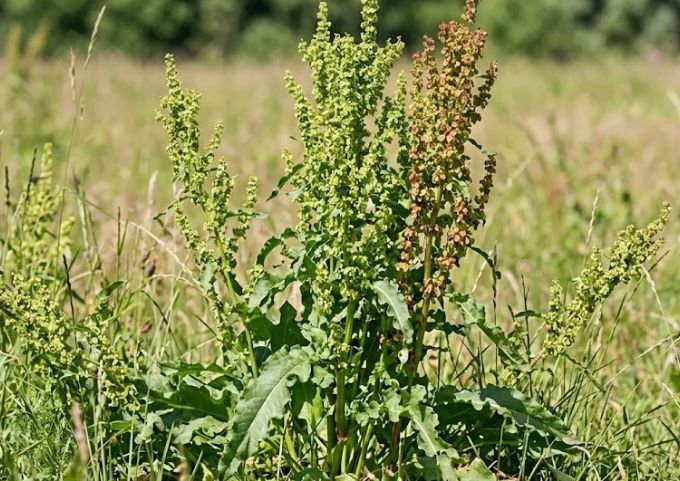
UC IPM describes a stout, erect stalk of 2 to 5 feet with swollen nodes, commonly unbranched below the flower head.
At each leaf joint, a thin papery sheath called an ocrea wraps the stem, a feature of the buckwheat family.
Small green flowers crowd in whorls along the upper branches, and UC IPM notes they can appear almost year-round in mild climates.
The tall stalk shows from a distance, so late season is the simplest time for working out how to identify yellow dock.
Stage Four: Rusty Seed Heads
Each seed is a glossy, reddish-brown, three-sided achene wrapped in three papery, veined wings, according to UC IPM.
Ontario’s guide adds that curly dock’s wings have smooth edges, while broadleaf dock’s wings carry irregular teeth.
By mid to late summer, the whole stalk turns rusty brown and can stand through winter, making the plant easy to spot in bare fields.
A single plant can carry up to 60,000 of these seeds, according to WSU Extension’s curly dock sheet.
The seeds themselves have a food history, set out in gathering and using dock seed.
Stage Five: Checking the Root
UMD describes a large yellowish taproot, and cutting into it should show yellow-tinged flesh under brown bark.
The root is a confirming sign, not a starting point, because digging should only follow certain identification above ground.
When you are ready to dig, the dock root harvest guide covers season, tools and site choice.
Plants Most Likely to Be Mistaken for It
Knowing how to identify yellow dock also means knowing what it is not.
Each comparison below links to a fuller article on that particular pairing.
- Red sorrel has slender red stems and arrowhead-like leaves, and UC IPM notes its flower parts lack teeth and tubercles.
- Broadleaf dock has much wider leaves with heart-like bases, and curly and broadleaf dock compared shows both side by side.
- Burdock grows huge, broad leaves and burred seed heads, and dock set against burdock covers the differences.
- Dandelion also forms a flat rosette, but its leaves are deeply toothed and ooze milky sap, as comparing dock with dandelion shows.
Using What You Have Identified
After mastering how to identify yellow dock, you can put the plant to several uses.
In Britain, dock leaves are the traditional rub for nettle stings, a folk habit weighed in dock leaves against nettle stings.
Gardeners who want a reliable, known patch can grow it on purpose, as raising yellow dock in a garden describes.
Both the leaves and the root carry cautions, from oxalates to laxative anthraquinones, listed in risks linked to yellow dock.
Drugs.com’s overview of the herb also advises against the root during pregnancy, with more in dock root during pregnancy.
Always consult your personal healthcare provider before adding new supplements to your routine, especially if you are pregnant, nursing, or taking prescription medications.
Conclusion
Curly dock shows long, narrow leaves of 10 to 30 centimeters with very wavy edges and a papery ocrea at joints.
Its stalk reaches 2 to 5 feet, then turns rusty brown with smooth-edged, three-winged seeds.
A yellowish taproot confirms the match, but only after every feature above ground agrees.
That combined check is how to identify yellow dock with confidence rather than guesswork.
When in doubt, leave the plant standing and ask a local botanist.
Get medical guidance if you plan any medicinal use, and keep Six Herbs handy.
Frequently Asked Questions
When is this plant easiest to spot?
Late summer and early fall work best, when the rusty brown seed stalks stand out. That season suits anyone practicing how to identify yellow dock by stalk and seeds.
Does yellow dock have red stems?
Curly dock stems are mostly green and stout, though Ontario’s guide notes reddish-purple blotches on some leaves. Slender, bright red stems usually point toward red sorrel, a smaller relative.
How tall does curly dock grow?
UC IPM gives 2 to 5 feet, and Maryland Extension lists flowering stalks up to 3 feet. Expect the height to vary with soil, moisture and local growing conditions.
What does the yellow dock seed look like?
Each seed is a glossy, reddish-brown, three-sided achene inside three papery wings with smooth edges. Wings edged with irregular teeth suggest broadleaf dock rather than curly dock.
Disclaimer: Six Herbs is an educational resource, not a medical service. Nothing in this article constitutes medical advice, diagnosis, or treatment. Always consult a qualified healthcare provider before using any herb medicinally, particularly if you are pregnant, breastfeeding, taking medication, or managing a health condition.

Chims Clements writes about herbs from personal experience and careful research. Growing up in Aba, Nigeria, moringa and tamarind were everyday household plants long before they became globally recognised superfoods. He uses both regularly in his home today. At Six Herbs he goes deep on moringa, tamarind, fenugreek, and sea moss — building honest, experience-backed content that separates what tradition knows from what science confirms. The content on this site is for informational purposes only and is not medical advice. Always consult a healthcare provider before using herbs medicinally.