
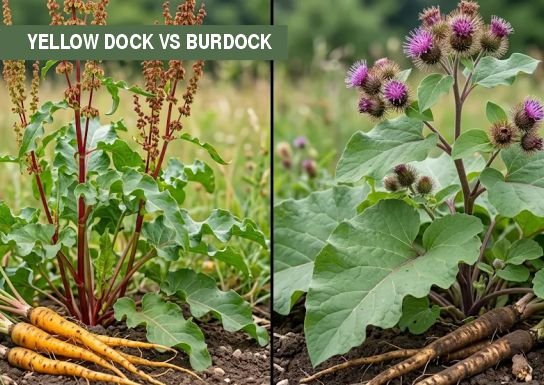
North Carolina State’s plant database lists burdock at up to 10 feet tall in its second year, with leaves like elephant ears. Next to that, yellow dock vs. burdock looks like no contest, yet the two roots share shelf space.
Both plants are Eurasian weeds with long taproots, both grow in disturbed ground, and both are sold in herb shops.
That overlap can lead buyers to treat them as interchangeable, when they come from different families and serve different purposes.
This look at yellow dock vs burdock relies on botanical and extension sources rather than personal use.
Short profiles come first, followed by the differences that matter in the field, the kitchen and the herb aisle.
If yellow dock is new to you, the central yellow dock page sets out the plant, its uses and its cautions in one place.
Safety note: yellow dock root is a laxative unsuitable in pregnancy, and any herbal root product should come from a supplier you trust.
Always consult your personal healthcare provider before adding new supplements to your routine, especially if you are pregnant, nursing, or taking prescription medications.
Two Plants, Two Families
Yellow Dock (Rumex crispus)
This buckwheat-family perennial has narrow, wavy leaves, a papery sheath at each leaf joint and rusty brown seed stalks. Its yellowish taproot is the part sold in herb shops as a bitter.
Burdock (Arctium lappa)
NC State’s Plant Toolbox places burdock in the aster family, a biennial with huge, heart-like leaves woolly underneath and purple flower heads. Those heads later become hooked burrs that cling to fur and clothing.
| Feature | Yellow dock | Burdock | Source |
|---|---|---|---|
| Family | Polygonaceae (buckwheat) | Asteraceae (aster) | Drugs.com, NC State |
| Life cycle | Perennial | Biennial | Maryland Extension, NC State |
| Leaves | 10 to 30 cm, narrow, very wavy, hairless | Up to 80 cm, heart-like, hairy beneath | Ontario weed guide, Alberta |
| Flowers | Small green whorls | Purple globular heads | UC IPM, NC State |
| Seeds | Three-winged and rusty brown | Hooked burrs | UC IPM, Alberta |
| Mature height | Between 2 and 5 feet | 2 to 10 feet in year two | UC IPM, NC State |
| Taproot | Yellowish, about a foot long | Fleshy, up to 1 m long | Urban Moonshine, Alberta |
| Main use | Herbal bitter root | Root eaten as a vegetable (gobo) | NC State |
Telling Them Apart in the Field
Leaf size settles most cases, since Alberta’s great burdock weed profile gives burdock leaves of up to 80 centimeters, far larger than any dock leaf.
Burdock leaves are hairy underneath, while yellow dock leaves stay smooth and hairless, with crisped edges.
Dock also carries a thin, papery sheath, the ocrea typical of buckwheat relatives, at the base of every leaf stalk, which burdock lacks.
In late season the difference is unmistakable, because burdock carries hooked burrs and dock carries rusty, three-winged seeds.
The full dock checklist is in field marks of yellow dock, and the wider mix-up list is in other plants mistaken for dock.
Roots: Kitchen Vegetable or Herbal Bitter?
The biggest practical gap in yellow dock vs burdock is what happens to the root after digging.
NC State lists burdock root as the plant’s primary edible part, known in Japanese cooking as gobo.
The same source adds that young leaves and immature flower stalks are edible before flowering begins.
Yellow dock root is not eaten as a vegetable, since Drugs.com’s yellow dock notes describe it as rich in laxative anthraquinones and tannins.
Instead, it goes into bitter preparations such as a simmered yellow dock tea or dock root in alcohol.
Its taste is sharply bitter, as the flavor of dock root describes in more detail.
Dandelion root, another common pairing, gets its own comparison in dock beside dandelion root.
Growing Habits and Harvest Timing
Burdock is a biennial, so cooks generally dig its root during the first year, before the plant bolts.
Yellow dock is perennial, and herbal sources prefer digging it in fall, as the yellow dock digging guide sets out.
Alberta’s profile gives burdock a fleshy taproot up to 1 meter long, so both plants demand patient digging with a fork.
Both thrive in disturbed ground such as roadsides and pastures, which makes clean site choice important for either harvest.
Buying the Right Root
Dried, chopped roots look much alike, so in a jar, yellow dock vs burdock comes down to the botanical name on the label.
Yellow dock should be labeled Rumex crispus, while burdock should read Arctium lappa, and herb label checks worth making lists other details to confirm.
Mislabeling is a known risk with herbal products, and a 1978 JAMA case report described atropine-like poisoning from a commercial burdock root tea.
The CDC documented a similar pattern in a 1994 MMWR report, where a contaminated herbal tea caused anticholinergic poisoning in seven people.
Buying from suppliers who test identity reduces that risk for both roots.
Safety Side by Side
Safety comparisons of yellow dock vs burdock start with the dock root, which has the clearer list of warnings in the sources used here.
Under Drugs.com’s guidance, yellow dock is off limits during pregnancy and breastfeeding and for people with bowel obstruction or kidney disease.
For burdock, NC State warns that its airborne bristles can cause severe eye, skin and respiratory irritation in people and animals.
Burdock’s own herbal cautions are beyond this page, so ask a pharmacist or doctor before using it medicinally.
Dock’s full warnings sit in dock root safety details, with pregnancy covered in yellow dock for pregnant women.
Always consult your personal healthcare provider before adding new supplements to your routine, especially if you are pregnant, nursing, or taking prescription medications.
Conclusion
Yellow dock is a buckwheat-family perennial with narrow, wavy, hairless leaves, an ocrea sheath and a deep, bitter yellow root.
Burdock is an aster-family biennial with leaves up to 80 centimeters, woolly undersides, purple flowers and clinging burrs.
Burdock root is eaten as gobo, while dock root stays in bitter teas, tinctures and syrups.
That is yellow dock vs burdock in short: different families, different roots and different jobs.
Check labels for Latin names, ask your doctor ahead of medicinal use, and let Six Herbs handle your next plant comparison.
Frequently Asked Questions
Is burdock just another name for yellow dock?
No, burdock is Arctium lappa, an aster, while yellow dock is Rumex crispus, a buckwheat relative. Their leaves, seed heads, roots and kitchen uses all differ in clear ways.
Can you eat burdock root like a vegetable?
Yes, NC State lists the root as burdock’s primary edible part, known as gobo. Yellow dock root is too bitter and laxative to treat the same way.
Which is easier to identify, yellow dock vs burdock?
Burdock is usually easier, thanks to leaves up to 80 centimeters and clinging burrs. Yellow dock needs closer checks of leaf edges, papery sheaths and rusty winged seeds.
Can I take yellow dock and burdock together?
Some herbal blends combine them, but no clinical evidence supports the pairing. Dock’s laxative compounds and pregnancy cautions apply, so ask a doctor before trying any blend.
Disclaimer: Six Herbs is an educational resource, not a medical service. Nothing in this article constitutes medical advice, diagnosis, or treatment. Always consult a qualified healthcare provider before using any herb medicinally, particularly if you are pregnant, breastfeeding, taking medication, or managing a health condition.

Chims Clements writes about herbs from personal experience and careful research. Growing up in Aba, Nigeria, moringa and tamarind were everyday household plants long before they became globally recognised superfoods. He uses both regularly in his home today. At Six Herbs he goes deep on moringa, tamarind, fenugreek, and sea moss — building honest, experience-backed content that separates what tradition knows from what science confirms. The content on this site is for informational purposes only and is not medical advice. Always consult a healthcare provider before using herbs medicinally.