
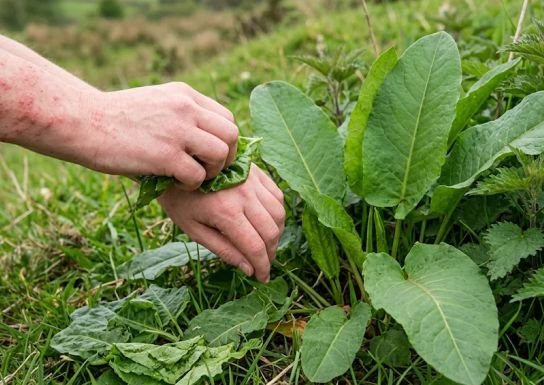
In 2024, nine emergency doctors had both forearms stung with fresh nettles, then dock went on one arm and lettuce on the other. The results suggest dock leaves for nettle stings may help, though plain lettuce did about as well.
Few plant remedies are as familiar in Britain as grabbing a dock leaf after brushing against stinging nettles.
The habit is centuries old, and dock and nettle tend to grow side by side along paths and field margins.
Neither nettle rash nor the dock leaf cure was part of growing up in Aba for me, so this article draws entirely on published sources.
It covers where the remedy comes from, what nettle hairs inject, and what the first trial of dock leaves for nettle stings found.
Readers wanting the plant’s wider story can turn to the curly dock master guide.
Safety note: seek emergency help at once for breathing difficulty, throat or lip swelling, or a rash spreading beyond the stung area.
Always consult your personal healthcare provider before adding new supplements to your routine, especially if you are pregnant, nursing, or taking prescription medications.
Table of Contents
A Remedy Older Than Chaucer
The University of Michigan’s Middle English Dictionary entry for dock records the phrase “nettle in, dok out” in Chaucer’s Troilus and Criseyde.
The dictionary dates the poem’s composition to about 1385 and explains that the phrase began as a charm.
People recited it while drawing the sting out of a nettle with a dock leaf, according to the same entry.
Chaucer used it figuratively for fickleness, which suggests the charm was already well known by the late 1300s.
What Nettle Hairs Actually Inject
Most explanations of dock leaves for nettle stings blame formic acid, but research points to other compounds doing most of the harm.
A 2006 study in Annals of Botany by Fu and colleagues analyzed the stinging hairs of Urtica thunbergiana, a nettle species from Taiwan.
The major constituents were histamine, oxalic acid and tartaric acid, while formic acid appeared only at low levels.
In rat tests, oxalic acid and tartaric acid produced persistent pain, whereas formic acid caused only moderate pain lasting about ten minutes.
That species is a relative of the common stinging nettle, so the findings may not transfer exactly to European plants.
The Alkaline Myth
A popular explanation says alkaline dock sap neutralizes the acid in a nettle sting.
Biologist Phil Gates rejects that idea in Discover Wildlife’s dock leaf article, pointing out that dock sap is acidic too.
Dock leaves also contain oxalic acid, the same compound Fu’s team linked to lasting nettle pain.
Gates suggests cooling from evaporating sap may ease the burning, while noting that no natural antihistamine in dock has been identified.
What the 2024 Trial Found
The first controlled test of dock leaves for nettle stings appeared in Emergency Medicine Journal in July 2024.
According to the BMJ Group press release, nine emergency department doctors took part in the randomized, double-blind trial.
Both forearms of each participant were brushed with nettle stems, then dock leaves went on one arm and sweet gem lettuce on the other.
| Measure | Dock leaf | Lettuce leaf |
|---|---|---|
| Drop in discomfort score at 5 minutes | About 3 points | About 2 points |
| Peak visible wheals | 27 on average | 20 on average |
| Time to peak wheals | 5 minutes | 5 minutes |
| Statistically reliable difference | No | No |
Discomfort fell quickly on both arms over 15 to 20 minutes, the press release reports.
The authors concluded that dock may work, lettuce may work just as well, and relief comes fast either way.
Limits of the Trial
- Nine participants is far too few for firm conclusions, as the authors themselves acknowledge.
- The study had no untreated arm, so it cannot show either leaf beats doing nothing.
- The press release describes the trial as mainly a team-building exercise and an introduction to research methods.
Using a Dock Leaf Safely
For anyone still reaching for dock leaves for nettle stings, correct identification comes first.
Check the plant using spotting true curly dock and dock’s risky lookalike plants, since foxglove rosettes can look similar.
Either common dock may be the leaf closest to hand, and broadleaf and curly dock side by side separates the two.
Pick a clean leaf away from roadsides and sprayed ground, as where to forage dock safely explains.
Crush it lightly to release sap, then dab rather than rub, because Patient.info warns that rubbing can push nettle chemicals deeper.
Missouri Conservation reports skin irritation in some people who handle dock, so stop if your skin worsens.
First Aid That Health Bodies Recommend
St John Ambulance’s nettle sting guidance advises washing the area with soap and water as soon as possible.
It also says not to scratch or rub the itchy skin, and to expect discomfort to ease within a couple of hours.
For severe irritation, the charity suggests a damp cloth or an ice pack wrapped in a tea towel.
A pharmacist can advise on antihistamines and creams, St John Ambulance adds, if itching persists.
Patient.info’s GP-reviewed nettle rash advice recommends lifting stray nettle hairs with strong tape or wax strips rather than bare fingers.
Signs of a Severe Reaction
Patient.info lists several symptoms that need emergency help straight away after a sting:
- Difficulty breathing, wheezing or persistent coughing in the minutes after the sting.
- Chest tightness, a racing heart or a feeling that the throat is closing.
- A swollen tongue or lips, or sudden trouble swallowing food or saliva.
- Rashes appearing on areas of skin that never touched the nettle plant.
- Vomiting, stomach pain or diarrhea developing in the hours following the sting.
Other Uses and Cautions for Dock
Dock leaves can also be eaten when young and cooked, as preparing dock greens to eat explains, though their oxalic acid demands moderation.
Their sour, lemony flavor gets a full write-up in what dock leaves taste like.
The root is a separate matter, with cautions set out in known yellow dock reactions and yellow dock before birth.
Always consult your personal healthcare provider before adding new supplements to your routine, especially if you are pregnant, nursing, or taking prescription medications.
Conclusion
The dock leaf cure dates back at least to Chaucer, whose poem preserved the charm “nettle in, dok out.”
Research now credits oxalic and tartaric acids, not mainly formic acid, with long-lasting nettle pain.
A small 2024 trial found dock helped, yet plain lettuce worked about as well, and there was no untreated comparison.
So dock leaves for nettle stings are harmless to try, but soap, water and cooling are the advised first steps.
Seek urgent care for any severe reaction, and browse Six Herbs for further evidence-led plant guides.
Frequently Asked Questions
Do dock leaves for nettle stings work?
A 2024 trial of nine doctors found dock eased stings, but lettuce worked similarly. Without an untreated comparison, cooling or natural recovery may explain much of the relief.
Is dock sap alkaline?
No, biologist Phil Gates notes that dock sap is acidic, so it cannot neutralize the sting. Dock also contains oxalic acid, one compound linked to persistent nettle pain.
What should you do first after a nettle sting?
St John Ambulance advises washing with soap and water as soon as possible, without scratching. Strong tape can lift stray hairs, and a cool compress eases severe irritation.
How long does nettle sting pain last?
St John Ambulance says the discomfort usually eases within a couple of hours. Patient.info notes a raised rash can sometimes last a few days, depending on the person.
Disclaimer: Six Herbs is an educational resource, not a medical service. Nothing in this article constitutes medical advice, diagnosis, or treatment. Always consult a qualified healthcare provider before using any herb medicinally, particularly if you are pregnant, breastfeeding, taking medication, or managing a health condition.

Chims Clements writes about herbs from personal experience and careful research. Growing up in Aba, Nigeria, moringa and tamarind were everyday household plants long before they became globally recognised superfoods. He uses both regularly in his home today. At Six Herbs he goes deep on moringa, tamarind, fenugreek, and sea moss — building honest, experience-backed content that separates what tradition knows from what science confirms. The content on this site is for informational purposes only and is not medical advice. Always consult a healthcare provider before using herbs medicinally.