
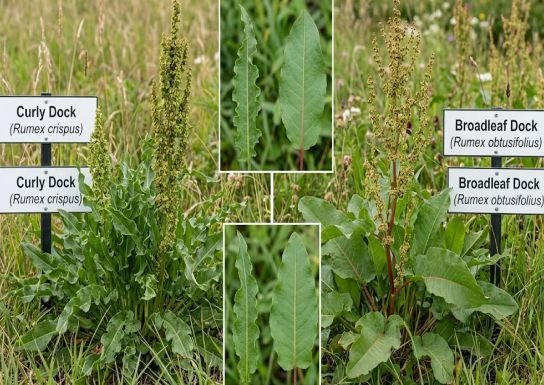
The Royal Horticultural Society measures broadleaf dock leaves at up to 15 centimeters wide, while curly dock leaves rarely pass 8 centimeters. That width gap settles most cases of curly dock vs broadleaf dock before you even check the seeds.
Both plants are common docks across the UK, North America and beyond, and both turn up in the same damp, disturbed ground.
Herbal yellow dock refers to curly dock, Rumex crispus, so telling the two apart matters for anyone buying, digging or cooking.
This comparison of curly dock vs broadleaf dock leans on horticultural and extension sources, since neither plant was part of my household herbs.
Each difference below names its source, including the places where those sources disagree.
Readers who want the herbal side of the story first can start with our yellow dock root explainer before this one.
Safety note: both docks contain oxalic acid, and the root is unsuitable during pregnancy, breastfeeding or kidney disease.
Always consult your personal healthcare provider before adding new supplements to your routine, especially if you are pregnant, nursing, or taking prescription medications.
Table of Contents
The Two Docks at a Glance
Curly Dock (Rumex crispus)
Curly dock has long, narrow leaves with strongly wavy, curled edges, usually no more than 8 centimeters wide according to the Royal Horticultural Society. Its seed wings have smooth edges, and its yellow root is the herbal yellow dock.
Broadleaf Dock (Rumex obtusifolius)
Broadleaf dock, or bitter dock, has oval leaves up to 30 centimeters long and 15 wide, with a heart-like base and slightly wavy margins. Its seed wings carry jagged, spreading teeth, which makes a dependable separating feature.
| Feature | Curly dock | Broadleaf dock | Source |
|---|---|---|---|
| Leaf width | Usually under 8 cm | Up to 15 cm | RHS |
| Leaf length | 10 to 30 cm | Up to 30 cm | Ontario weed guide, RHS |
| Leaf edges | Very wavy and curled | Slightly wavy, not curly | RHS, Ohio State |
| Leaf base | Narrow and tapering | Heart-like lobes | Ontario weed guide, Ohio State |
| Hairs | Hairless | Short white hairs under petioles and veins | UC IPM, Ohio State |
| Seed wings | Smooth edges | Jagged, spreading teeth | Ontario weed guide, Ohio State |
| Flower stem height | 2 to 5 feet | Up to about 4 feet | UC IPM, RHS |
| Taproot | Long and yellowish | Stout, yellow, up to 4 feet deep | Maryland Extension, RHS |
Leaves: The Fastest Way to Tell Them Apart
Leaf width is the quickest field check, since the RHS describes curly dock leaves as much narrower than broadleaf dock leaves.
Ohio State’s broadleaf dock record notes that broadleaf leaves are about twice as long as wide, with edges “somewhat wavy” rather than curly.
The same record mentions red veins or spots on rosette leaves and short white hairs under the petioles and veins.
Curly dock leaves, by contrast, are hairless, as UC IPM’s curly dock notes describe.
Broader identification of curly dock at every stage sits in spotting yellow dock by season.
Seeds: The Most Reliable Check
Ontario’s weed guide for docks says broadleaf dock’s papery seed wings have irregularly toothed margins, while curly dock’s are smooth.
Ohio State describes those broadleaf teeth as jagged and spreading, visible on close inspection of a dry seed head.
When leaves give a mixed picture, seed wings usually settle curly dock vs. broadleaf dock.
Because seed heads stand through winter, this check works for much of the year, not just at flowering.
Both species are prolific, and Ohio State credits broadleaf dock with as many as 60,000 seeds per plant.
Curly dock seeds have their own culinary history, covered in dock seed flour and foraging.
Roots and Regrowth
Both docks grow deep, yellow taproots, and the RHS says broadleaf dock roots can reach 1.2 meters, or about 4 feet.
The RHS adds that root sections deeper than about 12 centimeters rarely regrow, so removing the top 12 to 15 centimeters handles most plants.
Ohio State places broadleaf dock’s shoot buds in the upper 3 inches of the taproot, which explains why cutting alone rarely kills it.
Herbal yellow dock products use the curly dock root, so diggers should confirm species before lifting anything, following the dock root lifting guide.
Habitat and Range
The RHS lists both as native, widespread UK docks, and notes that 18 other Rumex species also carry the dock name there.
Ohio State finds broadleaf dock on floodplains, woodland edges and poorly drained, nutrient-rich soils, and notes curly dock tolerates acidic soil less well.
Hybrids between docks make identification difficult, the RHS warns, so some plants will sit between the two descriptions.
Uses: Kitchen, Herbal Shelf and Nettle Patch
In practice, the curly dock vs broadleaf dock question matters most for herbal buyers, because supplement labels name Rumex crispus.
Young leaves of curly dock are the ones usually described as potherbs, and cooking dock leaves safely covers preparation.
Across Britain, broad dock leaves get rubbed on nettle stings by tradition, and the dock leaf sting remedy weighs that habit against the evidence.
Growers who want a known, labeled patch of the right species can follow instructions for cultivating curly dock at home.
For other plants that are confused, see plants commonly confused with dock.
Safety for Both Species
Missouri Conservation’s dock profile warns that dock leaves carry enough oxalic acid to be a poor choice for people with kidney trouble.
For the root, Drugs.com’s Rumex crispus monograph advises against use during pregnancy or while breastfeeding, and lists kidney disease among its contraindications.
Fuller details sit within side effects of dock species and expecting mothers and dock.
Whatever the outcome of curly dock vs broadleaf dock in the field, cook leaves well and keep portions modest.
Always consult your personal healthcare provider before adding new supplements to your routine, especially if you are pregnant, nursing, or taking prescription medications.
Conclusion
Curly dock has narrow, very wavy leaves under about 8 centimeters wide and smooth-edged, papery seed wings.
Broadleaf dock has oval leaves up to 15 centimeters wide, heart-like bases, hairy veins and toothed seed wings.
Both send down yellow taproots, and hybrids can blur the line between the two species.
For herbal use, the answer to curly dock vs broadleaf dock matters because products name Rumex crispus.
Check leaves and seeds together, seek medical advice before treating either plant as medicine, and let Six Herbs settle the next plant question.
Frequently Asked Questions
Is broadleaf dock the same as yellow dock?
No, herbal yellow dock is curly dock, Rumex crispus, while broadleaf dock is Rumex obtusifolius. They are close relatives, but product labels and herbal references name curly dock.
Do both docks have yellow roots?
Yes, Ohio State describes a stout yellow root for broadleaf dock, matching curly dock’s yellowish taproot. Root color therefore cannot separate the two, so check leaves and seed wings.
What settles curly dock vs broadleaf dock fastest?
Measure a mature leaf, since the RHS puts curly dock leaves under about 8 centimeters wide. Jagged, toothed seed wings on the dry stalk then confirm broadleaf dock.
Do both docks regrow from the root?
Yes, the RHS says root sections regenerate, though pieces below about 12 centimeters rarely do. Removing the top 12 to 15 centimeters of root handles most plants well.
Disclaimer: Six Herbs is an educational resource, not a medical service. Nothing in this article constitutes medical advice, diagnosis, or treatment. Always consult a qualified healthcare provider before using any herb medicinally, particularly if you are pregnant, breastfeeding, taking medication, or managing a health condition.

Chims Clements writes about herbs from personal experience and careful research. Growing up in Aba, Nigeria, moringa and tamarind were everyday household plants long before they became globally recognised superfoods. He uses both regularly in his home today. At Six Herbs he goes deep on moringa, tamarind, fenugreek, and sea moss — building honest, experience-backed content that separates what tradition knows from what science confirms. The content on this site is for informational purposes only and is not medical advice. Always consult a healthcare provider before using herbs medicinally.