
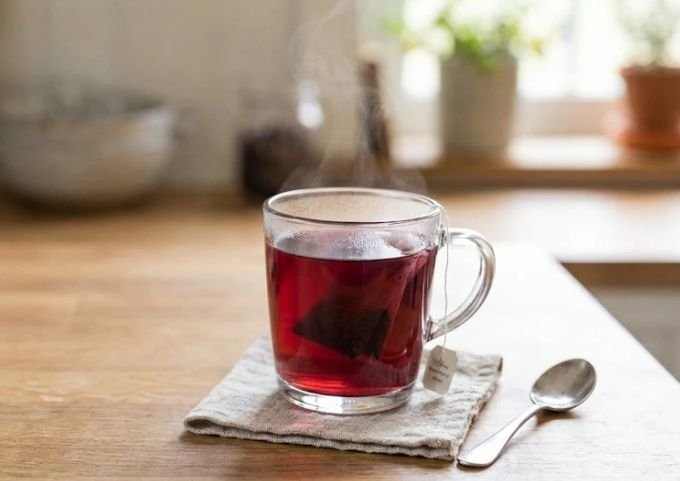
Most published elderberry recipes are for syrup, and very few university guides give any measurements for a simple cup of tea. Here is how to make elderberry tea by borrowing the safe simmering steps that those syrup guides already publish.
Moringa tea is part of my household routine in Aba, but our family kitchen has never brewed elderberries.
Because I have never brewed this drink myself, the safety steps below come from extension and federal sources, not my own cups.
This guide covers how to make elderberry tea using dried, fresh or frozen fruit, including a starting ratio, simmer time and careful straining.
It also covers flavor pairings, sweeteners, elderflower tea, store-bought tea bags and what to do with any leftover brewed pot.
For the shrub itself, from its species to the harvest season, start with our elderberry starting point.
Safety note: simmer elderberries thoroughly before drinking the tea, and never sweeten a cup with honey for a baby under 12 months.
Always consult your personal healthcare provider before adding new supplements to your routine, especially if you are pregnant, nursing, or taking prescription medications.
Table of Contents
How to Make Elderberry Tea at a Glance
Elderberry tea is a light infusion of simmered berries, closer to a hot fruit drink than to a cup of leaf tea.
| Step | What to do |
|---|---|
| Measure | 2 tablespoons dried berries, or 4 tablespoons fresh or frozen, per 2.5 cups water |
| Simmer | Covered, about 30 minutes |
| Strain | Fine strainer, pressing the berries lightly |
| Sweeten | Honey or sugar after a short cool, optional |
| Store | Drink the same day, refrigerating any leftover cup |
The ratio is a starting point for flavor, while the simmering step is the part that matters for safety.
Why Elderberry Tea Is Simmered, Not Steeped
Leaf teas like moringa are steeped off the heat, as shown in how we brew moringa, but elderberries need active cooking.
The NCCIH elderberry fact sheet, updated November 2024, warns that berries eaten raw or before ripening carry poisonous substances that produce cyanide.
The fact sheet warns of nausea, vomiting and diarrhea, then states that heat from cooking eliminates this toxin.
Drying does not cook the fruit, so a quick pour of boiling water in a mug falls short of published simmering methods.
The same reasoning rules out cold brewing, which never heats the berries at all.
Why cooking matters, and which parts of the plant to avoid, is set out in cooked versus raw elderberries.
How Long to Simmer
No federal or extension source I found sets a minimum simmer time for elderberry tea specifically.
Published syrup recipes give the closest guide, and they simmer berries far longer than a typical tea bag steeps.
- Illinois Extension’s elderberry article simmers dried berries with spices for one hour, or until reduced by half.
- The University of Vermont version cooks its berries for roughly 30 minutes before they are strained.
This guide uses a covered 30-minute simmer, matching the shorter of those published times, with the lid limiting evaporation.
Simmer longer, uncovered, if you prefer a stronger and slightly thicker brew with a deeper purple color.
Does Simmering Destroy the Color?
A 2015 Journal of Berry Research study heated elderberry pulp at 70, 80 and 90 degrees Celsius.
Anthocyanins, the pigments behind the purple color, had a half-life of 1.6 hours at 90 degrees and about 8 hours at 80 degrees.
The study tested pulp rather than tea, so the figures only suggest that a 30-minute simmer keeps much of the pigment.
Long, hard boiling is more likely to dull the drink toward brown, a shift the same study recorded at higher temperatures.
Ingredients and Equipment
Tea needs fewer ingredients than syrup, and most kitchens already hold everything except the berries.
Berries
Illinois Extension notes that fresh berries rarely reach grocery stores, so most elderberries are sold dried, commonly through online shops.
Wisconsin Extension’s elderberry page lists dried berries sold online at $20 to $30 per pound.
Fresh or frozen berries work too, provided every one is ripe and every stem has been pulled away.
Clearing stems quickly from a fresh harvest is covered in freezing clusters to strip berries.
Water and Spices
Use clean, cold tap or filtered water, and add whole spices rather than ground ones for a clearer cup.
Equipment
- A small saucepan with a lid, since covering the pot limits evaporation during the simmer.
- A fine-mesh strainer or a coffee filter to catch seeds and skins from the berries.
- A measuring spoon, since a steady ratio makes each pot taste the same as the last.
- A heatproof jug or teapot for serving, warmed first with hot water from the kettle.
How to Make Elderberry Tea Step by Step
These steps make about two cups, and they scale up easily for a larger pot shared with family.
Measure the Berries
Use 2 tablespoons of dried berries, or 4 tablespoons of fresh or frozen fruit, for 2.5 cups of water.
This is a suggested starting ratio for flavor, not a tested standard, so adjust it after your first pot.
Doubling the amount for fresh fruit mirrors the University of Maine syrup recipe for the same swap.
Why the fresh amount is larger is explained in water content of fresh berries.
Add Water and Spices
Put the berries, water and any whole spices in the saucepan, then bring everything to a gentle boil.
Simmer Covered
Lower the heat, cover the pan and simmer for about 30 minutes, stirring once or twice along the way.
Keep the liquid at a steady simmer with small bubbles, rather than a rolling boil that splashes and browns the brew.
Mash and Strain
Press the softened berries gently on the pan wall using the back of a spoon.
Pour the tea through a fine strainer into a warmed jug, and discard the seeds, skins and spices.
Sweeten and Serve
Let the tea cool for a few minutes before stirring in honey, so it is pleasant to sip and easy to taste.
Sweetness preferences vary, so begin with one small spoonful of honey and taste the cup before adding another.
Honey and Babies
Honey belongs only in cups for older children and adults, because of a serious illness that honey can cause in infants.
MSU Extension’s guidance on infants and honey warns against giving babies honey in any form before their first birthday.
For babies, skip the honey entirely, and ask a pediatrician before offering any elderberry drink at all.
Flavor Pairings
Elderberry tea takes well to warming spices and citrus, and each addition changes the cup in a different direction.
Cinnamon
A cinnamon stick simmered with the berries adds a warm aroma, and both the Maine and Illinois syrup recipes include one.
Ginger
A few slices of fresh ginger add heat, and both extension syrup recipes call for 2 teaspoons of chopped ginger.
Cloves
Cloves are strong, so one or two whole cloves are plenty for a two-cup pot of tea.
Lemon
A squeeze of lemon stirred in after straining adds a sharper, fresher note to the finished cup.
Elderflower Tea Is a Different Drink
Elderflower tea uses dried blossoms rather than berries, and European regulators treat it as a separate herbal product.
The European Medicines Agency’s elder flower assessment recognizes elderflower tea for early cold symptoms based on long-standing use, not clinical trials.
The agency limits that use to adults and adolescents over 12, and advises seeing a doctor if symptoms last beyond a week.
Blossoms and fruit differ in season, flavor and handling, as set side by side in blossoms versus ripe berries.
Store-Bought Elderberry Tea Bags
Tea bags are a shortcut, though knowing how to make elderberry tea from loose berries gives more control over strength.
- Read the ingredient list, since some products blend elderberry with other herbs, fruit pieces or added flavorings.
- Follow the brewing time and water temperature printed on the box, since the maker has set them for that blend.
- Check for the species name and the company’s contact details, following what a trustworthy label shows.
- Store opened boxes sealed and dry, using the same habits described in keeping loose herbs dry.
Storing Dried Berries and Brewed Tea
Dried berries keep longest sealed in airtight jars, kept dark, cool and clear of kitchen steam.
Drying your own harvest for the tea jar is covered in dehydrating a summer harvest, including dryness tests.
I found no tested storage time for brewed elderberry tea, so make only what you plan to drink that day.
Refrigerate any leftover cup promptly and discard it if it smells sour, fizzes or shows any mold.
For a drink base that keeps up to two weeks chilled, stir a spoonful of homemade syrup in hot water instead.
How long that syrup keeps, by recipe, is broken down in fridge and freezer syrup times.
Who Might Need Medical Advice First
Elderberry tea is a food-style drink, but some groups should get medical advice before drinking it regularly.
According to the NCCIH, research has not settled elderberry’s safety during pregnancy or breastfeeding, and some herbs interact with medicines.
Always consult your personal healthcare provider before adding new supplements to your routine, especially if you are pregnant, nursing, or taking prescription medications.
Conclusion
Learning how to make elderberry tea comes down to one rule, which is that the berries must be simmered, never steeped raw.
Start with 2 tablespoons of dried berries in 2.5 cups of water, covered, for about 30 minutes.
Strain out seeds and spices, sweeten to taste and keep honey away from babies under one year.
Elderflower tea is a separate drink with its own regulatory status and age limit.
Six Herbs has the berry-to-cup series, so try the syrup recipe next for a sweeter drink base that keeps longer.
Frequently Asked Questions
Can you steep elderberries like regular tea?
No, drying leaves the fruit uncooked, so simmer berries in a covered saucepan rather than a mug.
For boxed tea bags, follow the brewing directions printed by the manufacturer.
How long should elderberry tea simmer?
Published syrup recipes simmer berries for 30 to 60 minutes, so this guide uses 30 minutes, covered.
No official source I found sets a shorter safe time for tea.
Can you use fresh elderberries for tea?
Yes, how to make elderberry tea stays the same with fresh fruit, using double the dried amount.
Pull off every stem and green berry before the fruit is cooked.
Can babies drink elderberry tea with honey?
No, MSU Extension warns against honey in any form for babies under one, citing infant botulism.
Ask a pediatrician before offering any elderberry drink to a young child.
Disclaimer: Six Herbs is an educational resource, not a medical service. Nothing in this article constitutes medical advice, diagnosis, or treatment. Always consult a qualified healthcare provider before using any herb medicinally, particularly if you are pregnant, breastfeeding, taking medication, or managing a health condition.

Chims Clements writes about herbs from personal experience and careful research. Growing up in Aba, Nigeria, moringa and tamarind were everyday household plants long before they became globally recognised superfoods. He uses both regularly in his home today. At Six Herbs he goes deep on moringa, tamarind, fenugreek, and sea moss — building honest, experience-backed content that separates what tradition knows from what science confirms. The content on this site is for informational purposes only and is not medical advice. Always consult a healthcare provider before using herbs medicinally.