
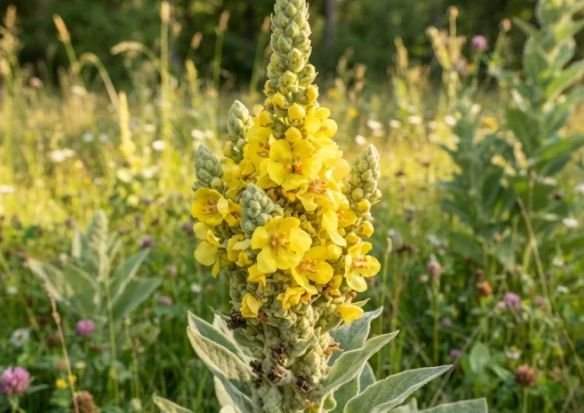
A south-eastern New South Wales plant guide lists mullein flowering from November to March, while Britain’s Wildlife Trusts give June to August. So the honest answer to when does mullein bloom depends first on which hemisphere your garden sits in.
Mullein flowers only in its second year, so timing depends on the season and the plant’s age.
Seasons in Aba run on rain and dry spells rather than summer and winter, so a calendar tied to summer bloom feels foreign to me.
Dates here come from extension services, wildlife trusts and regional floras across three continents, not from my own observation.
Foragers need the answer to when does mullein bloom to gather fresh flowers, and gardeners need it to cut stalks before seeding.
Anyone meeting mullein fresh may want a full mullein introduction first, then can return here for dates.
Safety note: mullein flowers appear in some herbal preparations, so ask a doctor first, especially if you are pregnant or nursing.
Always consult your personal healthcare provider before adding new supplements to your routine, especially if you are pregnant, nursing, or taking prescription medications.
Table of Contents
Bloom Months by Region of the Mullein Plant
Published flowering windows for mullein vary quite widely by region, as this table clearly shows.
| Region | Bloom months | Source |
|---|---|---|
| Ohio, USA | June to September | Ohio State Weed Guide |
| Illinois, USA | Summer, lasting about 1.5 months | Illinois Wildflowers |
| California valleys, USA | June to August | Cal-IPC |
| Eastern Sierra Nevada, USA | July to October | Cal-IPC |
| United Kingdom | June to August | The Wildlife Trusts |
| South-eastern New South Wales, Australia | November to March | Plants of South Eastern NSW |
Northern Hemisphere sites cluster around June to September, while Australian plants bloom across the southern summer.
North America
Ohio State’s weed identification record lists mullein blooming from June through September.
In California, the Cal-IPC species report gives June through August in the Sacramento and San Joaquin valleys.
The same report shifts bloom later, to the July to October period, in the cooler, higher eastern Sierra Nevada.
Illinois Wildflowers’ mullein page says blooming usually happens in summer and lasts about one and a half months.
That six-week figure sits inside much longer regional windows, probably because neighboring plants bolt at different times.
United Kingdom
In Britain, the Wildlife Trusts’ mullein entry gives a flowering season of June to August.
It describes candle-like yellow spikes made of small flowers packed into dense clusters.
The same entry notes that mullein moth caterpillars, spotted yellow and black, feed on the plant from May to July.
Moths, bees and other visitors are covered more fully in mullein’s insect visitors.
Australia
Mullein is an introduced weed in Australia, and its bloom follows the southern summer.
The south-east NSW plant guide lists flowering from November to March, with flower spikes 15 to 100 cm long.
That guide also records flowers 12 to 30 mm across, clustered in groups of one to seven above small leafy bracts.
Victoria lists mullein as a noxious weed, according to the same source, so local control rules may apply.
Weed status by state and country is covered in mullein’s weed listings.
Second Year Only
Mullein blooms only once, in its second year, and dies after setting seed.
UW-Madison’s weed profile of mullein notes that exposure to cold is required to induce flowering the following spring.
A first-year rosette normally will not flower that summer, however healthy it looks.
Cal-IPC records exceptions in California’s eastern Sierra, where plants can behave as winter annuals.
Stage-by-stage growth from rosette to flowering stalk is set out in rosettes before flowering.
How Flowers Open Through the Day
Mullein flowers keep short hours, which matters for anyone hoping to see or pick them.
UW-Madison reports each flower opening ahead of dawn and closing again by mid-afternoon.
Illinois Wildflowers adds that only a few flowers bloom at the same time on each spike.
So a stalk shows a scattered handful of open flowers each morning rather than a solid yellow column.
For flower gatherers, bloom timing therefore becomes a question of daily hours as well as months.
Morning picking, dry weather and other harvest details appear in picking mullein flowers and leaves.
What the Flowers Look Like
Illinois Wildflowers describes each flower as about three-quarters of an inch across, with five pale yellow petals and five hairy sepals.
Its three upper stamens carry white or yellow hairs, while the two lower stamens are hairless.
Ohio State calls the color sulfur-yellow, noting that white flowers occur rarely.
When cross-pollination fails, the flowers can pollinate themselves, according to Victoria’s great mullein archive page.
Bumblebees are the most important pollinators, Illinois Wildflowers says, with sweat bees and hover flies also visiting for pollen.
Bearded stamens and other floral clues also appear among mullein’s identifying features.
From Bloom to Seed
As each flower fades, a round, downy capsule forms in its place on the spike.
The Victorian archive counts 500 to 800 seeds in each capsule, with a single plant bearing 200 to 300 capsules.
Multiplied out, those counts give totals well into six figures for a single plant.
Timing for collecting that seed once capsules turn brown is covered in harvesting ripe mullein seed.
Gardeners wanting fewer seedlings can cut spikes during bloom, with methods in stopping mullein from spreading.
Tracking when mullein blooms in your local area therefore guides both flower gathering and weed control.
Always consult your personal healthcare provider before adding new supplements to your routine, especially if you are pregnant, nursing, or taking prescription medications.
Bloom Times for Other Herbs
Elderflowers have their own short early-summer season, described in elderflower versus elderberry.
Yellow dock flowers are small and greenish, quickly turning to rusty seed, as yellow dock plant identification shows.
Conclusion
Mullein blooms in summer, which means roughly June to September across most of North America and Britain.
In south-eastern Australia, the same plant flowers from November to March instead, during the warm southern summer.
Only second-year plants bloom, and their flowers unfold before sunrise, then fold closed by mid-afternoon each day.
Pinning down the bloom time for your own area means checking local flora records and watching nearby stalks.
Clear any flower use with a doctor first, and keep Six Herbs bookmarked for every remaining post in the mullein series.
Frequently Asked Questions
When does mullein bloom in the United States?
Ohio State lists a mullein blooming season running from June through September. California’s Cal-IPC report gives June to August in valleys and later dates in the eastern Sierra.
What months does mullein flower in Britain?
The Wildlife Trusts give a UK flowering season of June to August. Plants bloom only in their second year, after spending the first as a low, woolly rosette.
How long does a mullein plant stay in flower?
Illinois Wildflowers says the blooming period lasts about one and a half months. Only a few flowers bloom at once, each opening before dawn and closing by mid-afternoon.
Do mullein flowers self-pollinate?
Yes, when cross-pollination does not happen, according to Victoria’s archived state weed records. Bumblebees remain the most important pollinators, Illinois Wildflowers notes, alongside sweat bees and hover flies.
Disclaimer: Six Herbs is an educational resource, not a medical service. Nothing in this article constitutes medical advice, diagnosis, or treatment. Always consult a qualified healthcare provider before using any herb medicinally, particularly if you are pregnant, breastfeeding, taking medication, or managing a health condition.

Chims Clements writes about herbs from personal experience and careful research. Growing up in Aba, Nigeria, moringa and tamarind were everyday household plants long before they became globally recognised superfoods. He uses both regularly in his home today. At Six Herbs he goes deep on moringa, tamarind, fenugreek, and sea moss — building honest, experience-backed content that separates what tradition knows from what science confirms. The content on this site is for informational purposes only and is not medical advice. Always consult a healthcare provider before using herbs medicinally.