
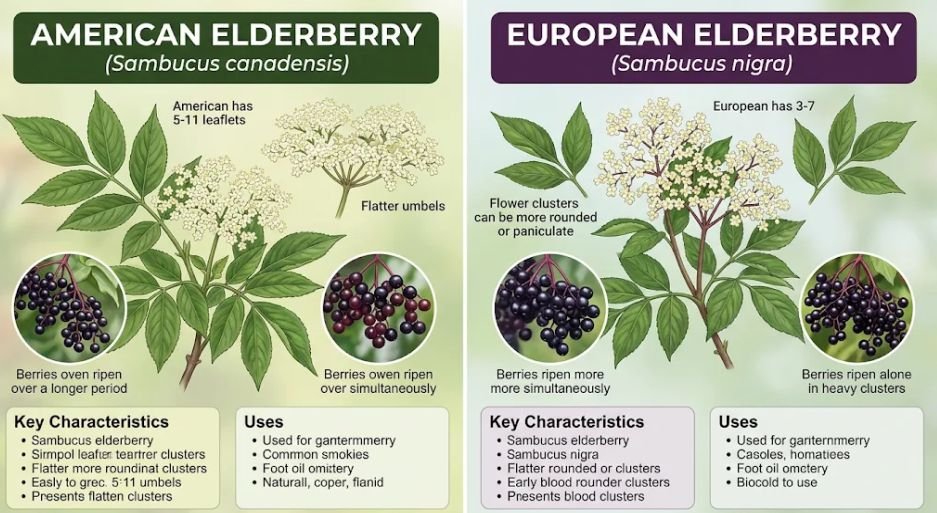
Botanists now file both plants under one species, Sambucus nigra, yet growers still treat them as separate crops. The American vs European elderberry split shows up in hardiness, berry size, acidity and cultivars, so the label on nursery tags matters.
Moringa shoppers soon learn that one plant can travel under many names, from drumstick tree to malunggay, and elder has the reverse problem.
Two subspecies share a single scientific name, and the confusion follows them into gardens, kitchens and supplement aisles.
Nothing here comes from my own plots, since the details are drawn from Rutgers, Wisconsin, Oregon State and federal researchers.
The American vs European elderberry traits are weighed one at a time, then tabled, followed by practical advice for growers and cooks.
The broader elder story, from safety to recipes, sits on the main elderberry page at Six Herbs.
Safety note: both elders need cooking before the berries are eaten, and neither should be canned with standard high-acid berry recipes.
Always consult your personal healthcare provider before adding new supplements to your routine, especially if you are pregnant, nursing, or taking prescription medications.
Table of Contents
One Species, Two Subspecies
Older books call American elder Sambucus canadensis, but current sources list it as a subspecies of Sambucus nigra.
Forest Service botanists name American elder S. nigra ssp. canadensis and European elder S. nigra ssp. nigra.
A third subspecies, blue elder, grows in the western United States and differs from both in acidity and fruit color.
Field features shared by all three are covered in spotting elder in the wild, season by season.
American vs European Elderberry, Trait by Trait
Each short profile below compares one trait, using extension and research sources named in the text.
Native Range
American elder is native to eastern North America, and the Forest Service lists it across most of the US and eastern Canada. European elder is native to Europe and parts of western Asia, though US gardeners also grow it.
Plant Form
Rutgers Cooperative Extension’s June 2025 fact sheet describes European elder as having a tree-like growth habit. American elder grows as a shrub instead, sending up multiple canes from the base rather than one trunk.
Cold Hardiness
Rutgers says American elder is better adapted to Northeastern US growing conditions than the European plant. The Wisconsin uncommon fruit profile adds that European elder is less cold hardy, listing zones 5 to 9.
Berry Size and Color
Wisconsin describes European fruit as slightly larger and darker than American fruit. Rutgers notes that American berries and flowers are slightly smaller but sweeter and more aromatic than their European counterparts.
Flowers
Both subspecies bloom with flat clusters of small creamy flowers in early summer. The Wisconsin author observed larger European flower clusters at one test site, while Rutgers describes American blossoms as more aromatic, so flavor and size trade off.
Acidity and Canning
The Oregon State elderberry preservation guide treats American berries as a low-acid food, since their pH is not consistently below 4.6. Limited data suggest European berries are higher in acid, though Oregon State still advises against standard canning for both.
Cyanogenic Compounds
A 2021 American elder analysis in Molecules found lower cyanogenic glycoside levels in fresh American berries than earlier studies reported for European fruit. Both still need careful removal of stems and green berries, and thorough cooking.
Cultivars
Rutgers lists American cultivars such as Adams I, Adams II, Johns, York and Nova. Wisconsin names European selections including Allesso, Korsor, Samdal and Samyl, though none of the tested ones adapted well to its trial site.
Commercial Use
Rutgers notes that European elder is the commercial crop in Europe, while its fact sheet promotes American elder for US growers. Wisconsin suggests European plants may outperform American ones on juice quality and yield, wherever they grow successfully.
Side-by-Side Table
The table below gathers the nine traits, with each entry drawn from the sources linked in the profiles above.
| Trait | American elder | European elder |
|---|---|---|
| Scientific name | S. nigra ssp. canadensis | S. nigra ssp. nigra |
| Native range | Eastern North America | Europe and western Asia |
| Plant form | Multi-caned shrub | Tree-like |
| Cold hardiness | Better suited to the US Northeast | Less cold hardy, zones 5 to 9 |
| Berries | Slightly smaller, sweeter | Slightly larger, darker |
| Flowers | More aromatic | Larger clusters at one site |
| Acidity | Low-acid, pH not reliably below 4.6 | Limited data suggest higher acid |
| Cyanogenic compounds | Lower in fresh berries, per 2021 study | Higher in earlier studies |
| Example cultivars | Adams, Johns, York, Nova | Allesso, Korsor, Samdal, Samyl |
Which One Suits Your Garden?
Settling American vs European elderberry for a garden depends on climate and goals, and most North American growers lean one way for good reason.
- In cold northern regions, American elder is the safer pick, given its proven hardiness in the Northeast.
- For a single specimen plant with a tree-like form, European elder may suit milder gardens in zones 5 to 9.
- For berries in quantity, a named American cultivar gives predictable results, with pruning advice in cutting back elder canes.
Home propagation from hardwood cuttings is described in starting new elder shrubs.
What the Difference Means in the Kitchen
In the kitchen, the American vs European elderberry question matters less, since cooks rarely know which subspecies filled a bag of dried berries.
A few simple habits cover both subspecies safely, whatever recipe you choose.
- Treat any elderberry as needing cooking, as set out in risks of uncooked fruit.
- Keep homemade syrup chilled or frozen, following the cooked syrup method rather than canning it.
- Choose tested, acidified recipes for any shelf-stable spread, such as the jelly covered in jam and canning rules.
Flavor differences between fruit types are described in what elderberries taste like.
Always consult your personal healthcare provider before adding new supplements to your routine, especially if you are pregnant, nursing, or taking prescription medications.
Conclusion
American vs European elderberry comes down to one species split into two subspecies with different strengths in garden and kitchen.
American elder is a hardy, multi-caned shrub with slightly smaller, sweeter fruit and more aromatic flowers.
European elder grows tree-like, is less cold hardy and bears slightly larger, darker berries.
American berries count as low-acid and European data remain limited, so neither type belongs in standard high-acid canning recipes.
Six Herbs has more on growing elder, so read the cuttings guide next and start a named American cultivar this season.
Frequently Asked Questions
Is American elderberry the same as European elderberry?
Both fall under one species, Sambucus nigra, but they are separate subspecies with different ranges, hardiness and fruit.
Growers and nurseries treat them as distinct crops with their own cultivars.
Which is better, American or European elderberry?
Rutgers favors American elder for Northeastern growers, while European elder may yield well in milder climates.
Choose the subspecies that matches your local winters, soil and growing conditions.
Can you can American vs European elderberry the same way?
Oregon State treats American berries as low-acid and advises against standard high-acid canning recipes for both subspecies.
Freeze or dry the berries instead, or follow a tested acidified recipe.
Are European elderberries safer to eat raw?
No, every elderberry needs cooking, though a 2021 study found fresh American berries lower in cyanogenic compounds.
Remove all stems and green berries before cooking either type of berry.
Disclaimer: Six Herbs is an educational resource, not a medical service. Nothing in this article constitutes medical advice, diagnosis, or treatment. Always consult a qualified healthcare provider before using any herb medicinally, particularly if you are pregnant, breastfeeding, taking medication, or managing a health condition.

Chims Clements writes about herbs from personal experience and careful research. Growing up in Aba, Nigeria, moringa and tamarind were everyday household plants long before they became globally recognised superfoods. He uses both regularly in his home today. At Six Herbs he goes deep on moringa, tamarind, fenugreek, and sea moss — building honest, experience-backed content that separates what tradition knows from what science confirms. The content on this site is for informational purposes only and is not medical advice. Always consult a healthcare provider before using herbs medicinally.