
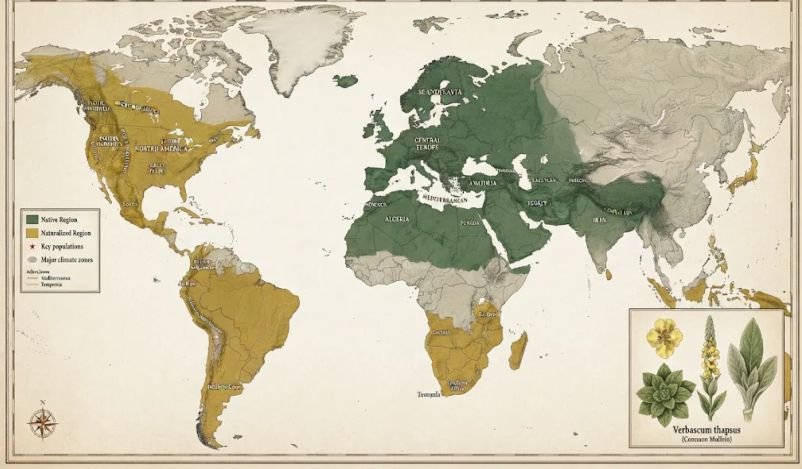
US Forest Service researchers record common mullein in every single US state, Alaska and Hawaii included, plus all southern Canadian provinces. So the quick summary of where does mullein grow is almost anywhere open, sunny and recently disturbed by people.
Mullein comes originally from Europe and western and central Asia, yet it thrives on several other continents.
Its spread comes down to a few needs: light, open ground, little competition.
The herbs of my Aba upbringing never included mullein, and no source consulted here for this particular post mentions Nigeria.
Range records and habitat notes come instead from the US Forest Service, Weeds Australia and Britain’s Wildlife Trusts.
Foragers who learn where does mullein grow can find clean stands faster, while land managers can predict new outbreaks.
Its history, uses and life cycle are gathered in our mullein starting point.
Safety note: mullein on roadsides or sprayed land may carry pollutants, so choose clean sites and ask a doctor before medicinal use.
Always consult your personal healthcare provider before adding new supplements to your routine, especially if you are pregnant, nursing, or taking prescription medications.
Table of Contents
Native and Introduced Range of the Mullein Plant
Weeds Australia’s mullein profile gives the native range as Europe and western and central Asia.
The table sums up where mullein grows as a native plant and where it was later introduced.
| Region | Status | Source |
|---|---|---|
| Europe, western and central Asia | Native | Weeds Australia |
| United Kingdom | Native, widespread | Weeds Australia, The Wildlife Trusts |
| United States | Introduced, recorded in all 50 states | USDA Forest Service FEIS |
| Canada | Introduced, all southern provinces | USDA Forest Service FEIS |
| Australia | Introduced, every state and the ACT, not recorded in the Northern Territory | Weeds Australia |
North America
Early settlers likely brought mullein to the eastern United States more than 230 years ago, according to the FEIS mullein review.
The same review says the seeds were reportedly grown so settlers could use the plant to stun fish.
Colorado listed it as a common weed by 1905, and Hawaii first recorded it in 1932.
By 1990, Hawaiian infestations spanned upward of 770 square miles, the review adds.
Alaska’s 1968 flora did not list it, which points to a more recent arrival there.
How High Mullein Climbs
Mullein climbs surprisingly high in the American West, based on state floras compiled in the Forest Service review.
| State | Elevation range |
|---|---|
| Arizona | 5,000 to 7,000 ft |
| California | Below 7,200 ft |
| Colorado | 4,500 to 9,000 ft |
| Nevada | 4,000 to 8,700 ft |
| New Mexico | 6,000 to 8,500 ft |
| Utah | 4,000 to 9,010 ft |
Elsewhere in the US, the review notes that elevation tolerances are not as wide.
Habitats It Favors
Given a seed source and an opening, the review says mullein can colonize nearly any community, from prairies to coniferous forests.
Typical sites are disturbed ones such as roadsides, shores, fields, clearings and vacant lots.
In Australia, Weeds Australia lists roadsides, old settlements, rocky outcrops, waste areas, sandy pastures, dry creek beds and forest margins.
Britain’s Wildlife Trusts’ habitat notes point to dry, grassy ground, waste ground, gardens and roadside verges.
Across all three regions, its preferred habitat comes down plainly to open ground that something has recently disturbed.
Soil
Soil type is probably not a limiting factor, the Forest Service review concludes.
Reported soils range from light soils in Nova Scotia to heavy soils in Wisconsin and coarse soils on the Great Plains.
Researcher Reinartz found that it thrives on dry, infertile, highly calcareous, or lime-rich, soils as long as sunlight is abundant.
Weeds Australia likewise notes a preference for dry, well-drained or sandy sites of low fertility.
Rich, moist garden soil is not required, which helps explain its success on gravel and roadsides.
Sunlight and Shade
Light matters far more than soil, since mullein is a plant of open sites.
In West Yellowstone, it appeared only where canopy cover was under 30 percent, with 75 percent of records at 5 percent cover or less.
Germination is best in full light on the soil surface, and large plants in shade typically die or fail to reproduce.
Weeds Australia also describes great mullein as shade intolerant, matching the North American findings.
That is why dense forests and thick lawns rarely host mullein for long.
Climate and Rainfall
In Australia, mullein mostly keeps to temperate regions with over 500 mm of annual rain and moderate summers.
Some populations also occur in subtropical and semi-arid areas, the same profile adds.
North American researchers suggested a general-purpose genotype, with similar photosynthesis rates between 20 and 35°C (68 to 95°F).
That flexibility lets mullein cope with short Canadian summers as well as long, wet southern seasons.
Competition and Disturbance
Mullein struggles against established vegetation, which keeps it tied to disturbed ground.
Seedling growth was dramatically lower among established Kentucky bluegrass than on bare soil or litter, the review reports.
Storms, logging, thinning, fire and overgrazing all create the openings it needs.
In Oregon’s Wallowa Mountains, frequency hit 23 percent three years after clearcutting and burning, then fell to 3 percent or less by year 14.
Populations usually fade as other plants recover, though seed can wait in the soil for more than 100 years.
Regional weed laws and ecological impacts are covered in mullein’s legal weed status.
Clearing an unwanted patch is the subject of pulling and cutting mullein.
Finding Clean Mullein to Gather
For foragers, where mullein grows matters far less than where it grows cleanly.
Roadside plants are a poor choice, since Kansas State’s mullein production bulletin warns that traffic pollution can reach them.
Overgrazed pastures and sprayed field edges may host mullein too, but their history is hard to know.
Meadows with known histories, or your own garden, make safer gathering spots.
Picking technique, timing and site checks are covered in gathering mullein leaves safely.
Growing a patch at home avoids the guesswork, as sowing your own mullein describes.
Before picking anything, double-check the plant’s name with mullein field identification checks.
Always consult your personal healthcare provider before adding new supplements to your routine, especially if you are pregnant, nursing, or taking prescription medications.
Where Other Six Herbs Plants Grow
Yellow dock shares mullein’s taste for disturbed ground, as where yellow dock thrives describes.
Moringa, a tropical tree whose leaves I use daily, sits a world apart from mullein’s temperate range, as moringa’s full profile shows.
Conclusion
Mullein’s homeland is Europe and western and central Asia, but introduced populations now span North America and Australia.
It grows across all 50 states of the US, southern Canada, every Australian state and high western slopes.
Open sun, disturbed ground and little competition matter far more to it than soil type ever does.
So mullein grows best wherever light is plentiful and the soil has recently been opened up by some disturbance.
Gather from clean sites, seek a physician’s advice on medicinal use, then check Six Herbs for new posts.
Frequently Asked Questions
Where does mullein grow in the United States?
The Forest Service review records it in all 50 states, including Alaska and Hawaii. It favors sunny, recently disturbed sites such as roadsides, fields, clearings and vacant lots.
Does mullein grow in shade?
Rarely, since West Yellowstone records found it only below 30 percent canopy cover. Large plants in deep shade die or fail to reproduce, according to Forest Service researchers.
What soil does mullein like?
Soil type rarely limits mullein, according to the Forest Service’s species summary. It thrives on dry, infertile, lime-rich soils and well-drained or sandy sites, provided sunlight is plentiful.
Is mullein a native North American plant?
No, common mullein originally comes from Europe and western and central Asia. European colonists carried it into the eastern United States more than 230 years ago, records suggest.
Disclaimer: Six Herbs is an educational resource, not a medical service. Nothing in this article constitutes medical advice, diagnosis, or treatment. Always consult a qualified healthcare provider before using any herb medicinally, particularly if you are pregnant, breastfeeding, taking medication, or managing a health condition.

Chims Clements writes about herbs from personal experience and careful research. Growing up in Aba, Nigeria, moringa and tamarind were everyday household plants long before they became globally recognised superfoods. He uses both regularly in his home today. At Six Herbs he goes deep on moringa, tamarind, fenugreek, and sea moss — building honest, experience-backed content that separates what tradition knows from what science confirms. The content on this site is for informational purposes only and is not medical advice. Always consult a healthcare provider before using herbs medicinally.