
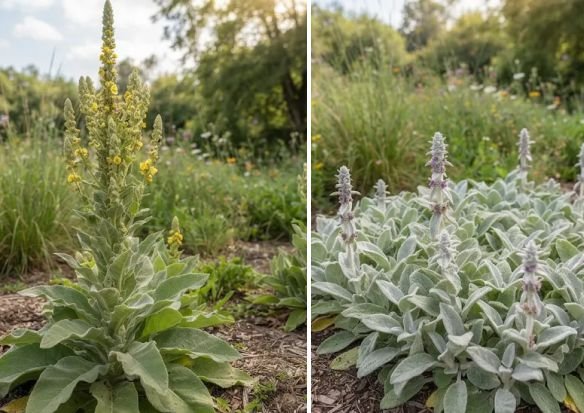
NC State Extension lists lamb’s ear stems up to 20 inches tall, while Ohio State records mullein flowering stalks reaching 8 feet. Height is only one of many clear differences in mullein vs lamb’s ear, starting down at leaf level.
Both plants wear thick, pale wool, and both begin as low rosettes, so a quick glance can easily mislead a new forager.
Years of plant work around Eastern Nigeria from 2010 have made me wary of leaf judgments, though neither plant has reached my hands.
NC State, Ohio State, UW-Madison and Britain’s Royal Horticultural Society supply the plant records behind every contrast here.
Settling mullein vs lamb’s ear matters most for anyone gathering leaves to dry, since only one is the plant they want.
History, uses and growing notes for the whole plant sit together on our main mullein page.
Safety note: confirm any fuzzy plant is mullein before picking, and ask a doctor before using mullein medicinally, especially if pregnant or nursing.
Always consult your personal healthcare provider before adding new supplements to your routine, especially if you are pregnant, nursing, or taking prescription medications.
Table of Contents
Side-by-Side Comparison of Mullein and Lamb’s Ear
Extension and RHS figures put the differences between mullein and lamb’s ear side by side in one table.
| Feature | Common mullein | Lamb’s ear | Sources |
|---|---|---|---|
| Botanical name | Verbascum thapsus | Stachys byzantina | Missouri Plants, NC State |
| Family | Figwort (Scrophulariaceae) | Mint (Lamiaceae) | Missouri Plants, NC State |
| Life cycle | Biennial | Perennial | Ohio State, NC State |
| Rosette leaves | Up to 15 inches, oblong, bluish gray-green | 4 to 6 inches, oblong-elliptic, silvery-green | Ohio State, UW-Madison, NC State |
| Leaf arrangement on stems | Alternate | Opposite | Ohio State, NC State |
| Stem | Round, winged by leaf bases | Four-angled (square) | Missouri Plants, NC State |
| Flowers | Sulfur-yellow, flat, five-lobed | Purplish-pink, two-lipped, tubular | Ohio State, NC State, UW-Madison |
| Bloom time | June to September | May to July | Ohio State, NC State |
| Flowering height | Up to 8 feet | Up to 20 inches | Ohio State, NC State |
| Spread | By seed | Mats spreading by rooting stems | UW-Madison, NC State |
| Native range | Europe and Asia | Turkey, the Caucasus and Iran | UW-Madison, NC State |
Leaves: Size, Color and Feel
NC State’s lamb’s ear plant profile describes leaves 4 to 6 inches long, thick, velvety and densely white woolly.
Their color is silvery-green, with pointed tips and gently scalloped edges along each blade.
Mullein rosette leaves tend to run larger, spanning 6 up to 15 inches with blunt, rounded ends, according to Ohio State’s mullein weed record.
UW-Madison’s mullein write-up gives mullein leaves a bluish, gray-green cast, unlike the silvery-white look Wisconsin horticulturists describe for lamb’s ear.
One catch is the ‘Big Ears’ cultivar, whose leaves reach up to a foot long, as UW-Madison’s Big Ears profile notes.
That cultivar overlaps mullein in leaf size, so size alone cannot settle the question.
Texture differs too: lamb’s ear hairs are long, white and silky, while mullein hairs are branched and star-like, according to Missouri’s Verbascum field notes.
By touch, lamb’s ear is described as velvety, while Ohio State compares mullein to frosted flannel.
Stems and Leaf Arrangement
The stem gives a dependable answer once either plant sends up a flowering spike.
Lamb’s ear belongs to the mint family, and NC State describes its stems as four-angled, square in cross-section.
Missouri Plants describes the mullein stem as round or slightly angled, and winged by leaf tissue running down from each leaf.
Roll a stalk between finger and thumb, and four flat sides point clearly toward lamb’s ear.
Leaf arrangement helps as well, since lamb’s ear leaves sit in opposite pairs along the stem, per NC State.
Ohio State lists mullein’s later leaves as alternate, with a single leaf at each point along the stalk.
Checking stem angles and leaf pairs settles most identification puzzles between the two in seconds.
Flowers
Flowers end any doubt, because the two plants bloom in completely different colors and forms.
Ohio State describes mullein flowers as sulfur-yellow, flat, five-lobed and packed tightly along a tall spike.
Lamb’s ear carries purplish-pink, two-lipped tubular flowers in whorls on woolly spikes, as UW-Madison and the RHS plant entry describe.
The RHS adds that those whorls sit on an interrupted spike, with gaps between clusters.
Wisconsin horticulturists note the dense hairs partly hide lamb’s ear flowers, and some gardeners cut the spikes off entirely.
Lamb’s ear blooms from May to July, according to NC State, while mullein flowers from June through September.
More on mullein flower form and timing appears in mullein’s summer flower spikes.
Height and Growth Habit
Mullein stands as a single upright stalk reaching 8 feet at most during its second season, says Ohio State.
Lamb’s ear stays low, with NC State listing a height of 1 to 1.5 feet and stems up to 20 inches.
Rather than rising, lamb’s ear spreads sideways, rooting at its stem nodes to form a low, carpet-like mat.
NC State warns that this spreading can turn aggressive in good conditions.
Mullein, meanwhile, spreads by seed rather than creeping stems, with UW-Madison estimating each plant sets anywhere from 100,000 to as many as 240,000 seeds.
Life Cycle Through the Year
As a biennial, mullein spends year one as a rosette and year two flowering, seeding and dying.
How each stage looks gets its own walkthrough in mullein’s two-year life cycle.
Lamb’s ear is a perennial that returns from the same clump each year, which the RHS rates as hardy below minus 20°C.
Wisconsin horticulturists add that lamb’s ear stays evergreen in mild winters but dies back almost to the ground in cold areas.
Winter mullein, by contrast, leaves tall brown seed stalks standing, a sight covered in mullein’s winter skeleton.
Where Each Plant Grows
Lamb’s ear comes from the rocky hills of Turkey, the Caucasus and Iran, according to NC State.
Gardeners grow it for edging, groundcover and sunny rock gardens, among the uses Wisconsin horticulturists list.
Mullein instead turns up wild on disturbed, open ground such as roadsides, pastures and vacant lots.
As a rough rule of thumb, a fuzzy plant edging a garden border points to lamb’s ear, and one on waste ground to mullein.
This is a location hint, not proof, so always confirm with stems and flowers.
Mullein’s preferred soils and wider range are described in mullein’s favored growing spots.
Quick Field Test
Whenever a fuzzy-leaved plant leaves you unsure on a country walk, simply work through these checks in turn.
- Roll the stem between your fingers, feeling for four flat sides that signal lamb’s ear.
- Look at the leaf pairs, since opposite leaves point to lamb’s ear and alternate leaves to mullein.
- Check the flowers, where purple-pink tubes mean lamb’s ear and flat yellow blooms mean mullein.
- Measure the flowering stalk, since NC State lists lamb’s ear stems at up to 20 inches.
- Note the setting, treating garden borders and wild waste ground as hints rather than proof.
- Run through the full field checklist in the mullein identification walkthrough before picking anything.
Why the Difference Matters for Tea Makers
Mullein leaves are the ones dried and steeped for herbal tea, following mullein tea step by step.
Lamb’s ear is grown mainly as an ornamental, and none of the extension or RHS pages reviewed here cover it as a tea herb.
Picking the wrong plant wastes a harvest at best, so confirm identity before gathering, as the mullein picking calendar advises.
Always consult your personal healthcare provider before adding new supplements to your routine, especially if you are pregnant, nursing, or taking prescription medications.
More Look-Alike Pairs
Look-alike pairs turn up across many herbs, and side-by-side checks help each time.
Yellow dock and burdock share big basal leaves, compared in detail in yellow dock beside burdock.
Elderberry has its own set of risky lookalikes, sorted out in elderberry’s confusing cousins.
Conclusion
Mullein and lamb’s ear share soft, woolly leaves and low rosettes, but most other features set them apart.
Lamb’s ear has square stems, opposite leaves, purple-pink tubular flowers and a spreading perennial habit.
Mullein has round, winged stalks up to 8 feet, alternate leaves and flat, sulfur-yellow flowers on a spike.
Separating the two reliably takes stems and flowers, not leaves alone, especially with large-leaved garden cultivars around.
Check stems and flowers before harvesting, get medical advice before using mullein medicinally, and follow the Six Herbs series as it continues.
Frequently Asked Questions
Are mullein and lamb’s ear easy to tell apart?
Yes, once flowers appear, since mullein blooms yellow and lamb’s ear purple-pink. Before flowering, compare leaf size, leaf tips and the low, carpet-like spreading mats lamb’s ear forms.
Is lamb’s ear a type of mullein?
No, lamb’s ear is Stachys byzantina, a mint family perennial, while common mullein is Verbascum thapsus. They belong to entirely different plant families despite their similarly woolly leaves.
Does lamb’s ear grow as tall as mullein?
No, NC State lists lamb’s ear flowering stems at up to 20 inches tall. Ohio State records second-year mullein flowering stalks reaching 8 feet, roughly five times taller.
Does lamb’s ear come back every year?
Yes, lamb’s ear is a perennial that also spreads by rooting stems. Wisconsin horticulturists say it stays evergreen in mild winters but dies back sharply in cold areas.
Disclaimer: Six Herbs is an educational resource, not a medical service. Nothing in this article constitutes medical advice, diagnosis, or treatment. Always consult a qualified healthcare provider before using any herb medicinally, particularly if you are pregnant, breastfeeding, taking medication, or managing a health condition.

Chims Clements writes about herbs from personal experience and careful research. Growing up in Aba, Nigeria, moringa and tamarind were everyday household plants long before they became globally recognised superfoods. He uses both regularly in his home today. At Six Herbs he goes deep on moringa, tamarind, fenugreek, and sea moss — building honest, experience-backed content that separates what tradition knows from what science confirms. The content on this site is for informational purposes only and is not medical advice. Always consult a healthcare provider before using herbs medicinally.