
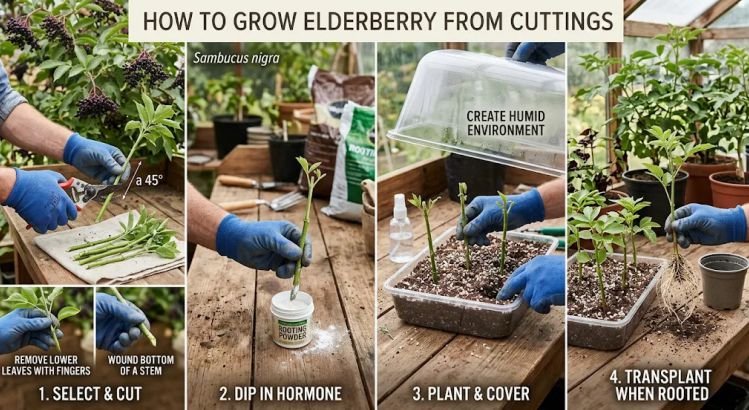
Florida researchers report that one elder cane can yield 8 to 10 hardwood cuttings, each needing just two nodes to root. That generosity makes how to grow elderberry from cuttings worth learning, since one shrub can stock a whole row.
Cassava farmers across southeastern Nigeria plant stem pieces rather than seed, and elder can be multiplied in much the same way.
Rooting elder itself sits outside my own fieldwork, so the timings below come from Ohio State, Florida and California extension trials.
Dormant hardwood canes are the easiest starting point, with softwood and root cuttings offered as backups for other seasons.
For anyone asking how to grow elderberry from cuttings, a seasonal calendar comes first, then eight numbered steps, a troubleshooting table and young-plant care.
Newcomers can find the wider picture, from berries to blossoms, on our elder overview page.
Safety note: take cuttings only from plants you have identified with certainty, and wear gloves when handling sap, stems and leaves.
Always consult your personal healthcare provider before adding new supplements to your routine, especially if you are pregnant, nursing, or taking prescription medications.
Table of Contents
A Propagation Calendar
Timing decides most of how to grow elderberry from cuttings, so plan the year before cutting a single cane.
| Season | Task | Source |
|---|---|---|
| Late winter, January to March | Collect dormant hardwood cuttings before buds break | UF/IFAS Extension, Ohio State |
| Late winter to early spring | Root cuttings in pots, or store them chilled for several weeks | Ohio State |
| Late March to April | Dig root cuttings once the ground thaws | Ohio State |
| Spring, after the last frost | Move rooted cuttings into the garden | UF/IFAS Extension |
| Early summer, before flowering | Take softwood cuttings, kept under mist | UF/IFAS Extension, Ohio State |
Hardwood cuttings are the method most growers use, and the steps below follow that route.
Choosing the Parent Plant
A healthy, correctly identified parent is the foundation for every cutting you take.
- Confirm the shrub is elder using an elder identification checklist, since cuttings carry no flowers or berries to help.
- Choose a named cultivar if possible, because seedlings and wild plants vary widely in fruit quality.
- Compare subspecies before you start, as described in American and European types.
- Pick canes free of insect, disease and cold damage, which Ohio State calls critical for success.
- Rule out impostors such as pokeweed or prickly devil’s walking stick using common elder impostors.
Wild blue elder in California carries an extra rule, because the UC ANR propagation page points cutting-takers to guidance on the protected valley elderberry longhorn beetle.
How to Grow Elderberry From Cuttings in Eight Steps
These steps follow the hardwood method set out by Ohio State and Florida extension specialists.
1. Cut Dormant Canes
Ohio State’s South Centers guide names February and March as suitable months for collecting dormant canes from the previous season’s growth.
Florida’s guide places the window from January to March, before bud break.
2. Divide Canes Into Sections
The UF/IFAS cultivation guide, published in October 2020, describes taking up to 8 to 10 cuttings per cane, each with two nodes.
Ohio State allows two to four nodes, while the California page suggests cuttings at least 10 inches long.
3. Mark the Top and Bottom
Cut the top end straight and the bottom end at a slant, so the right way up is obvious later.
Planting a cutting upside down is an easy mistake, and this simple habit prevents it.
4. Chill or Root Straight Away
Ohio State notes that hardwood cuttings can sit in the refrigerator for several weeks before rooting.
Wrap bundles in damp paper and a plastic bag, so the canes stay moist but not wet.
5. Consider Rooting Hormone
Florida reports that dipping the base in a 0.1 percent IBA rooting hormone may help, though cuttings also root well without it.
Ohio State’s own trial found that rooting hormone made little measurable difference to results.
6. Pot in a Clean Mix
Ohio State roots cuttings directly in sterile commercial potting mix, while California suggests perlite and peat moss or sand.
Push each cutting in so at least one node sits below the surface and one stays above.
7. Keep Warm and Moist
Ohio State advises keeping cuttings warm and moist, and notes that buds break before roots form.
Do not mistake new leaves for success, because good rooting takes about 4 to 6 weeks.
8. Plant Out After Frost
Florida says potted cuttings should be well rooted within six to eight weeks and moved outdoors after the last frost.
Its guide prefers direct planting under drip irrigation where growers have that option.
Other Ways to Propagate
Hardwood cuttings are not the only route, and each alternative suits a different time of year.
Softwood Cuttings
Florida describes softwood cuttings taken in the growing season before flowering, potted in a sterile peat and sand mix.
Ohio State adds that softwood cuttings need an intermittent misting system until they root well.
Root Cuttings
Ohio State notes that root pieces can be dug in late March or April, and one root cutting may yield several plants.
Suckers
Elder suckers freely, and the California page lists digging suckers among the alternative propagation methods.
When Cuttings Fail
Elder roots easily in most trials, yet the California page warns of relatively low success with wild blue elder.
| Problem | Likely cause | Fix |
|---|---|---|
| Leaves appear, then wilt | Buds broke before roots formed | Keep moist and wait the full 4 to 6 weeks |
| Cutting rots at the base | Mix too wet or not sterile | Use fresh sterile mix and improve drainage |
| No growth at all | Planted upside down or dead cane | Check the slanted end points down |
| Few cuttings root | Low-rooting wild stock | Start with more cuttings than you need |
Caring for Young Plants
The last stage of how to grow elderberry from cuttings is aftercare, since the first two seasons set up years of harvests.
- Space plants 5 to 7 feet apart, as Penn State Extension’s planting advice recommends, given their wide, shallow roots.
- Plant at least two cultivars no more than 60 feet apart, since Penn State notes elder is wind-pollinated.
- Remove flowers for the first year or two, so energy goes into roots and foliage.
- Give 1 to 2 inches of water per week during dry spells, the amount Florida’s guide suggests.
Those removed flowers can still be used fresh, as compared in flowers versus fruit.
Florida expects full production three to five years after planting, with a first harvest possible in year two.
Cane management for older shrubs is covered in pruning established elder, and berry timing in when fruit is ready.
Always consult your personal healthcare provider before adding new supplements to your routine, especially if you are pregnant, nursing, or taking prescription medications.
Conclusion
Knowing how to grow elderberry from cuttings starts with dormant canes cut between January and March.
Divide each cane into pieces with two to four nodes, pot them in sterile mix and keep them warm and moist.
Roots form in about 4 to 6 weeks, and plants move outdoors after the last spring frost.
Space shrubs 5 to 7 feet apart, plant two cultivars and remove the early flowers.
Six Herbs tracks elder from first cutting to finished recipe, so read the pruning guide next to keep young shrubs productive.
Frequently Asked Questions
When is the best time to take elderberry cuttings?
Take hardwood cuttings in late winter, January to March, before buds break, as Florida and Ohio State advise.
Softwood cuttings can be taken in early summer, before the shrub flowers.
How long do elderberry cuttings take to root?
Ohio State and Florida both report good rooting in about 4 to 6 weeks.
Keep the potting mix evenly moist and warm throughout that waiting period.
Do elderberry cuttings need rooting hormone?
No, Ohio State found hormone made little difference, though Florida says a 0.1 percent IBA dip may help.
Untreated cuttings and treated cuttings both tend to root well in trials.
Is learning how to grow elderberry from cuttings hard?
It is one of the easier propagation jobs, since elder roots readily from two-node hardwood pieces.
Wild blue elder in California can root less reliably, so take extra cuttings.
Disclaimer: Six Herbs is an educational resource, not a medical service. Nothing in this article constitutes medical advice, diagnosis, or treatment. Always consult a qualified healthcare provider before using any herb medicinally, particularly if you are pregnant, breastfeeding, taking medication, or managing a health condition.

Chims Clements writes about herbs from personal experience and careful research. Growing up in Aba, Nigeria, moringa and tamarind were everyday household plants long before they became globally recognised superfoods. He uses both regularly in his home today. At Six Herbs he goes deep on moringa, tamarind, fenugreek, and sea moss — building honest, experience-backed content that separates what tradition knows from what science confirms. The content on this site is for informational purposes only and is not medical advice. Always consult a healthcare provider before using herbs medicinally.