
Last updated on September 17th, 2026 at 09:06 am
Tamarind seed gum sounds like a marketing buzzword, but it’s actually one of the more thoroughly researched parts of the plant. Scientists have studied its molecular structure for decades, and it shows up in actual drug-delivery systems, not just smoothies.
Tamarind seed gum is the purified, industrial version of what’s inside the tamarind seed, distinct from the whole roasted seed powder covered elsewhere on this site.
This guide covers its chemical structure, how it’s actually extracted at scale, and where it shows up in food, pharmaceuticals, cosmetics, and industry today.
I also correct one common overstatement: the digestion benefits commonly claimed for this gum apply more accurately to whole tamarind seeds than to the purified polysaccharide itself.
If you want the whole-seed version for everyday cooking or gut health, our tamarind seed powder guide covers that territory in full instead.
Disclaimer: Six Herbs is an educational resource, not a medical service. Nothing in this article constitutes medical advice, diagnosis, or treatment. Always consult a qualified healthcare provider before using any herb medicinally, particularly if you are pregnant, breastfeeding, taking medication, or managing a health condition.
Table of Contents
What Is Tamarind Seed Gum?
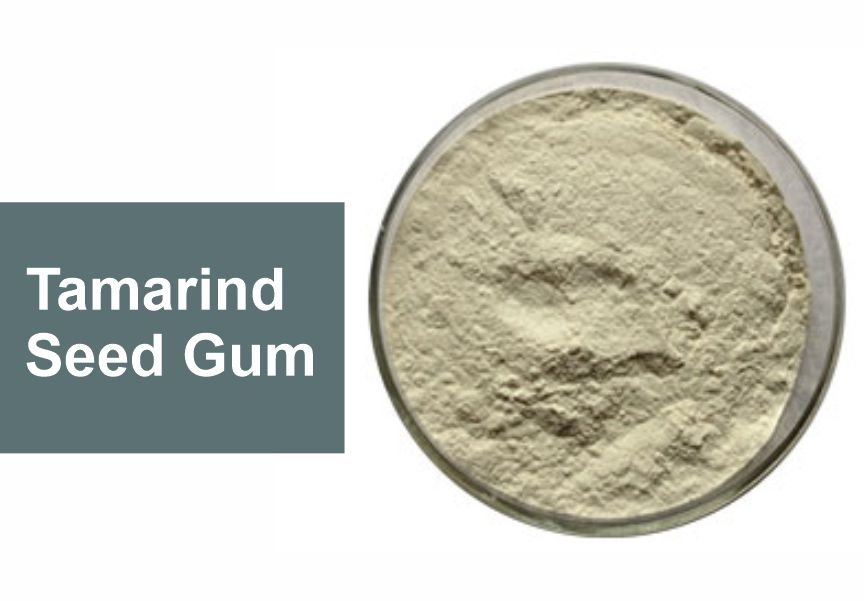
Tamarind seed gum, also called tamarind seed polysaccharide or TSP, is a natural polysaccharide extracted from tamarind seeds and used as a thickening, stabilizing, and gelling agent.
It’s a different product from whole tamarind seeds and from tamarind seed powder, since it’s an isolated, purified fraction rather than the ground whole seed.
Japan approved it as a food additive as far back as 1964, and it has been studied in food science and pharmaceutical journals ever since.
Composition: The Actual Chemistry
Tamarind seed polysaccharide is a xyloglucan built from a glucose backbone with xylose and galactose side chains, typically reported in roughly a 3:2:1 ratio.
Independent studies confirm strong heat, salt, acid, and freeze resistance, along with thickening, gelling, emulsifying, and water-retention properties, detailed in this review of tamarind seed polysaccharide structure and food applications.
Its high molecular weight, commonly reported between 720 and 880 kDa, is part of why it performs so reliably as a thickener.
How Tamarind Seed Gum Is Extracted
- Seeds are cleaned, dried, and dehulled to remove pulp and the hard outer coating.
- The exposed kernel is ground into a fine powder to increase surface area.
- The powder is mixed with hot water or a mild alkali solution to release the polysaccharide.
- The mixture is filtered to remove insoluble fragments and impurities.
- The purified extract is dried and ground into a fine, uniform powder ready for use.
Practical Uses: Food, Pharmaceutical, and Industrial
Food industry
Tamarind seed gum thickens sauces, jams, and beverages, and works as a natural emulsifier that keeps oil and water phases stable in dressings and dairy products.
Pharmaceutical applications
This is where the research gets notably interesting. A study modifying tamarind seed polysaccharide into a mucoadhesive polymer found it supported a steady, controlled drug release pattern over ten hours.
This is detailed in a study on thiolated tamarind seed polysaccharide for drug delivery.
A broader review of the compound’s biomedical uses confirms it has been explored for oral, buccal, ocular, and wound-dressing drug delivery.
See this review of tamarind xyloglucan in drug delivery for the full picture.
It has also been used as an anti-inflammatory agent and as an ingredient in artificial tears for dry eye treatment, according to this review of tamarind seed polysaccharide applications.
Cosmetic and industrial uses
Its water-binding capacity makes it useful in skincare formulations for smoothness and hydration, alongside tamarind seed oil in similar cosmetic applications.
Industrially, it has a long history in textile sizing, particularly in printing disperse dyes on polyester fabric, along with use in adhesives and paper production.
What About Digestion? A Correction Worth Making
Tamarind seed gum commonly gets credited with supporting digestion and gut health, the same way tamarind seeds generally are.
This claim deserves more care than it usually gets. The purified gum is typically used in food at only 0.1 to 1 percent of total weight, functioning as a texture agent rather than a meaningful fiber source.
The digestion and gut-bacteria claims actually apply to whole tamarind seeds and tamarind seed powder, eaten in far larger amounts, not to a trace-level thickening additive.
If digestive support is your actual goal, the whole-seed forms are the more honest choice.
Safety Considerations
Tamarind seed gum is generally recognized as safe for use in foods, supplements, and cosmetic products at typical levels.
Very high intake beyond normal usage levels may cause mild digestive discomfort, bloating, or gas in some people.
Rare allergic reactions, including skin irritation, are possible, so anyone trying it for the first time should start with a small amount and watch for any reaction.
How to Use It at Home
A small pinch stirred into smoothies or juices thickens the drink naturally without altering the flavor much.
In sauces or dressings, a small amount whisked in during gentle heating helps prevent separation and improves mouthfeel.
In baking, it can support moisture retention in gluten-free or low-fat doughs. Home bakers should experiment carefully, since exact percentages vary by recipe and haven’t been standardized for kitchen use the way industrial food science has done.
Conclusion
Tamarind seed gum earns its place in food science and pharmaceuticals through documented chemistry, not marketing hype.
Its xyloglucan structure gives it proven thickening, stabilizing, and mucoadhesive power, all backed by decades of published research.
The digestion claims commonly attached to this specific gum actually fit whole tamarind seeds better than the purified polysaccharide itself.
Used correctly and in appropriate amounts, it remains a solidly useful, plant-based ingredient across several very different industries.
See our tamarind seed powder guide for the fuller whole-seed nutrition and culinary side of the story.
Frequently Asked Questions
Is tamarind seed gum the same as tamarind seed powder?
No, seed gum is the purified polysaccharide extracted from the seed, while seed powder is the whole roasted or dried seed ground into flour for everyday cooking use.
What is tamarind seed gum actually used for?
It works as a natural thickener, stabilizer, and gelling agent in foods, and as a mucoadhesive polymer in pharmaceutical drug-delivery systems, plus cosmetics and several other industrial applications.
Does tamarind seed gum actually support digestion?
Not clearly for the purified gum itself; that fiber-based digestion claim applies far more accurately to whole tamarind seeds and seed powder, which contain far more usable fiber.
Is tamarind seed gum safe to consume?
Yes, it’s generally recognized as safe in typical food and pharmaceutical amounts, though very high intake beyond that may cause mild bloating or digestive discomfort in some people.

Chims Clements writes about herbs from personal experience and careful research. Growing up in Aba, Nigeria, moringa and tamarind were everyday household plants long before they became globally recognised superfoods. He uses both regularly in his home today. At Six Herbs he goes deep on moringa, tamarind, fenugreek, and sea moss — building honest, experience-backed content that separates what tradition knows from what science confirms. The content on this site is for informational purposes only and is not medical advice. Always consult a healthcare provider before using herbs medicinally.